
Edited by: Daniella Gutierrez
The Voice of Central New Mexico College
Edited by: Daniella Gutierrez

By Hailey Tolleson, Staff Reporter
The spring semester of 2018 is embracing the future by welcoming a new English class.
Digital Storytelling is an English class which will teach students how to utilize technology to get audiences engaged in a story, said the instructor of English 2096, Brain Hudson.
Since more and more people are getting their news and entertainment from the internet, the transition to an all-encompassing medium seems natural, he said.
What’s interesting about this class is that since students are going to use a combination of text, audio, photography film and/or graphics, the possibilities for how they can express a story are endless. Also, by adding an interactive element, audiences get more invested than if they were only presented with one element alone, he said.
“Digital storytelling could be particularly helpful in connecting people to other cultures as well as their own since it’s a relatively new platform especially in the west, it still remains to be shaped, inviting artists and writers to determine how they are depicted,” Hudson said.
For instance, a program is in the works to develop a Cherokee computer programing language
and those students will be encouraged to use that information to develop their own stories, using their own langue, he said.
“The digital world is everything now and if you don’t see yourself represented, if you don’t see your culture represented, if it’s all someone else’s culture you’re not going to connect to it” said Hudson.
There’s also an important place for it in activism as is exemplified by Elizabeth Lapensèe’s video game, Thunderbird strike.
The video game protests the Dakota access pipeline by having players pose as a mythical bird that shoots lightening at the oil line and is intercut with photos of protesters, said Hudson.
The business industry has also expressed an interest in Digital storytelling for its application in marketing and so has the medical field for its potential to help patients better articulate past history to professionals and keep track of their health, according to Hudson.
This class aims to attract a wide variety of students, from writers to artists to computer programmers, with a wide variety of interests to create collaborative community that utilizes everyone’s strengths and supports each other, he said.
Hopefully, this will lead to creating a digital storytelling culture with in the Southwest that will reach other countries and eventually global connections and recognition, he said.
If anyone is interested in taking digital storytelling, they should also take CIS 1325 visual communication as a co-requisite, which will cover more of the visual aesthetic side of digital storytelling, he said.
Digital storytelling will not require any special software or books, only a notebook, pencil, and computer access, and at the end of the semester, students will showcase their work on campus, he said.

February 20, 2017. By Hilary Broman
Senior Staff Reporter
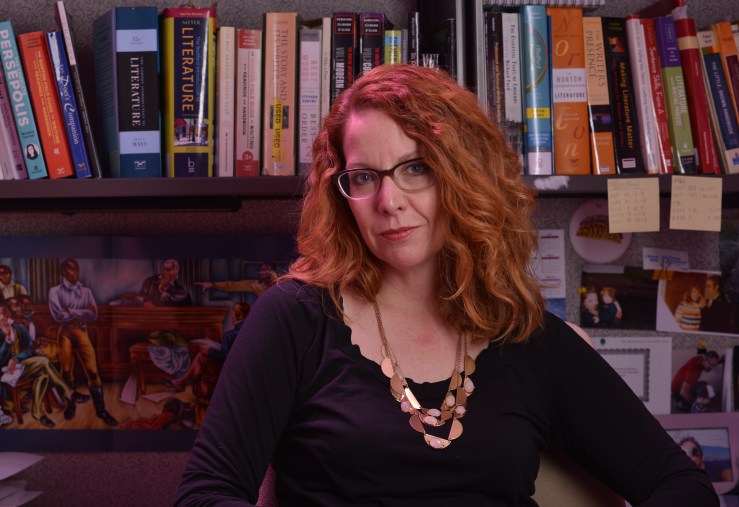
Erin Adair-Hodges, CNM English instructor, is scheduled to release her first book of poems titled, “Let’s All Die Happy,” this fall, she said.
She was the winner of the Pitt Poetry first book prize at the University of Pittsburgh Press, Hodges said.
The book is told through a woman’s lens and is very much about the world as experienced as a woman in this culture, she said.
“It investigates lots of different ways in which the world can wear on girls and women,” she said, “as young girls, as daughters, for some of us, as mothers, and as lovers.”
It is also an investigation of apostasy and a loss of faith in religious and cultural institutions, she said.
“What happens when you no longer find meaning in those, where do you find meaning?” Hodges said.
There is also a real dark humor throughout the book, she said.
Hodges has always been interested in Creative writing and she received a Masters degree in poetry, she said.
She stopped writing after she received her degree because she had to work many jobs to make ends meet and she felt, in many ways, that her voice didn’t matter, she said.
“I had been led to feel as if my voice and my perspectives weren’t valuable,” Hodges said.
About three years ago, after the birth of her son, Hodges began to think about bringing poetry back into her life, she said.
“I started thinking about who I am outside of my obligations, which is something I think that’s especially important for women to do because too often we get defined by our relationships and obligations to others,” she said.
Hodges decided to commit to making poetry a priority, she said.
“I only started getting published in journals and then getting my book taken when I treated poetry like a job and not just a fun hobby,” Hodges said.
Hodges ended up creating an early draft of her manuscript at the end of 2014 and the version that won the Pitt Poetry Prize was complete in early 2016, she said.
“It was pretty fast”, she said, “but I think it happened so quickly because it had been years of me storing up all of that energy and focus and because I felt like since I was getting a late start, I had no time to lose.”
Hodges worked closely with Rebecca Aronson, another CNM instructor who also published a book this year, to provide each other feedback, she said.
“Although we write very differently, we’ve become really good critics of each other’s work,” she said.
Hodges and Aronson both won contests within six months of each other and Hodges is genuinely happy for Aronson’s success, she said.
“There is plenty of space for lots of great work to be out there. I like to celebrate my friends who get their work recognized,” she said.
Hodges’ poetry was recently featured on PBS NewsHour, she said.
She was asked to submit a poem that spoke to the current climate in this country, she said.
She submitted a poem called, “The Jennifer Century.” Click here to read.
Hodges attributes a lot of her success to being able to rediscover her own weirdness, she said.
“I was a deeply creative, weird thinker and then I lost it for a long time,” Hodges said, “I think becoming a more successful writer was a process of getting back to that original, almost childlike way of processing the world.”
Hodges said that she sees this in students all the time. They give her answers that they think she wants to hear and that’s not the case.
“What I want is their unique, fresh take, formed by their experiences,” she said, “What can you, as an entirely unique person, with entirely unique perspectives bring to this that we’ve never heard before?”
With that, Hodges encourages students to explore classes that are not just a part of their degree program but classes that will help them see their lives differently, she said.
“Poetry has absolutely been that in my own life,” Hodges said.
Hodges’ book is scheduled to be released in the fall, she said.
Her book will be able to be purchased through her website and the University of Pittsburgh Press website.
By Carol Woodland, Staff Reporter
An exciting change is coming for students pursuing an Associate of Arts in English degree from CNM said Stephen Mathewson, chair of the English department.
Starting in fall of 2014 students will be able to pursue an AA in English completely online, he said.
“So you can take all of the core requirements within English but also within CHSS ( Communication , Humanities and Social Sciences) for the AA in English online,” Mathewson said.
Online courses will offer classes that include British, English and World Literature, as well as a class on literature analysis, Mathewson said.
The AA degree in English is also undergoing a revision to make transferring to the University of New Mexico a clearer process by synchronizing CNM with UNM requirements, he said.
“If students check UNM’s degree requirements online, they will see what ours will be. It’s a much more streamlined process especially at the sophomore level, and in the fall of 2015 our degree will match UNM’s revisions,” Mathewson said.
Currently students can choose from numerous different literatures and writing classes that include special topics course, such as Science Fiction Literature that will be offered at the West Side campus, a script writing class offered through the Theater department, and Film as Literature class which is already offered every semester, Mathewson said.
Despite the selection of course offerings, there has been low enrollment for some of the classes, English Professor, Rebecca Aronson said.
“This semester we didn’t have a poetry class on the Main campus because there was a dip in enrollment,” she said.
Aronson said she thinks that there are many great reasons why students should take Poetry or Creative Writing classes ranging from practical reasons to more expressive purposes.
“I think that on the imagination side, it’s a chance for people to express themselves, or sometimes just vent, follow their imaginative paths and do a freer kind of writing than academic writing,” she said.
In addition, students can gain a deeper connection to their lives and ideas when students write down their thoughts and aspirations, Aronson said.
Examining literature in English class can be an unexpected way to learn about culture by looking at literature from other countries or from the past, Aronson said.
“I think that poetry really is a good reflector of culture, time and place. You’re going to learn things about culture and what’s happening, and what that part of the world is like,” she said.
Reading literature from other countries can also help to get students informed about things they might not necessarily be learning from the news, Aronson said.
Mathewson said he thinks the skills students take away from English classes are essential in any professional environment.
“Not just writing emails, I think students don’t realize how much writing happens at work: proposals, grants, annual reports, revenue statements, those types of skills are universal,” he said.
Good writing skills, critical thinking, and analysis of all types of texts are all valuable skills developed in English classes, Mathewson said.
Writing for digital media, creative non-fiction, and professional writing are some of the biggest markets for English majors to start careers in right now Mathewson said, he also said he thinks that technology has been a catalyst to this growth.
“There’s sort of this misconception that texting is going to destroy writing, where actually the opposite is true,” he said.
Professional writing, which most people think of as technical writing, is not necessarily writing technical manuals and medical or government documents, Mathewson said.
From writing grants and proposals to critical analysis of nontraditional nonfiction, there are many interesting niches within professional writing, he said.
Though the field may be growing quickly writers still need to develop strong English skills in order to succeed in any field, Mathewson said.
“Digital media sort of exploded in a lot of ways, but within that explosion you still need to punctuate correctly and make sure subjects and verbs agree,” Mathewson said.
One way students can dig a little deeper into English is by taking 2240, a class in traditional English grammar, Mathewson said.
“In the last year or so Erin Lebacqz has revived 2240, which is a class that a lot of folks in education curriculums take but a lot of English majors take as well. It’s not really a writing improvement class, but sort of the theories behind grammar,” Mathewson said.
The track that students are taking to earn an English degree is evolving and changing to meet the needs of today’s workforce, Mathewson said.
“I think that it’s certainly changed from when I was a student. It’s become much more expansive and the traditional arrangements of English departments are no longer what they were,” Mathewson said.
For students still unsure of whether or not to pursue English as a degree, the English department has put together a video at the CNM YouTube website (youtube.com/users/ CNMonline) called “Why is Writing Important?,” and shows people from all different walks of life talking about how to use the skills students have developed in English classes, Mathewson said.
Aronson said that students sometimes avoid or fear taking English classes and should not have to feel that way because learning English is just like any other subject and that with practice people can learn to be great writers.