Nine Pieces of Advice for Women in Nontraditional Jobs.

Feature story and photos by Heather Hay

International Women’s Month may be winding down, but CNM’s lecture on Women in Nontraditional Jobs performed at the Montoya campus has provided students with lots of concrete advice for women entering the work force.

Here are nine pieces of advice from Police Captain Andrea Taylor, Fire Department Captain of the Arson Investigation Division Jackie Lance-White, and engineer and part time CNM instructor Srividya Iyer.

drivers
City Fire Department Drivers Erin Brandow and Jesse Davis were on available at the Montoya H building to answer students’ questions about getting a job.  Brandow said the CNM Fire science program is a good way to prepare yourself for becoming familiar with the equipment and concepts of fire fighting.
  1. You’re going to have to prove yourself.

Iyer said that she still has to remind men in her field that “women can do math” so remind them that you have the same experience and education as them and that yes, women are also good at math.  She said that a lot of girls grow up with society giving them a subtle put down in school that you are not smart enough to do math and science.

Iyer said she had worked with four women engineers out of 300 at Motorola in her department and there has been no increase in women engineers lately.  She said you have to prove yourself and work twice as hard.  “There is a lot of attrition.  Right off the bat there are subtle put downs that you are a woman and you cannot do it.”

She also recommends letting your hard work speak for itself.  She said “The most competent people I work with never brag about what they do.”

Taylor said the academy was hard but standards are the same for women and men so she was encouraged by her other students.  Her captain really wanted her to succeed and out of the five women in her class she was the only one left.  Currently, she said there are only about 10% women in her department and out of 320 sworn in, they have about 30.

  1. You must have passion for your work.

Lance-White said that seeing the best and worst parts of humanity is not for everybody.  “You delivery babies and you go to child rapes. It’s difficult to see that day in day out.”  She also said that the firefighter suicide rate is pretty high right now.  To be in the job you have really got to love helping people she said.

Taylor agreed with the sentiment of making your job a passion.  She said that even though the graveyard shift can be tough, but it is the best job and she can’t imagine sitting at a desk all day.

She said the “I didn’t do this job for the glamour and the glitz or driving with lights and sirens. It was to help people.”

Iyer also loves her job in engineering where she makes network equipment, routers and she was even on the design team for the razor cell phone.  She said “The most rewarding thing is building things and getting them to work.”  She also said there can be some boring mundane stuff in the beginning of your education or training, but engineering is actually a very creative job.

Dayana
Dayan Hill dropped in to hear the event out of curiosity because she is interested in learning about the careers.  She said “Each woman was different, but they shared similarities and in the end I think the message is the same; we can do it.”
  1. Have a strong support system and a way to decompress.

After long hours of stress on the job, Taylor says it’s a good idea to have separate life outside of work where you can decompress.  She said a lot of cops have ADHD and PTSD so you need a strong support system.

At home, Taylor cares for a special case rescue dog that had been abused.  “My work life balance is a lot simpler for me because when I put my hair down and I take off my uniform you would not recognize me,” she said.  When she is done with work she works out, rescues animals, gardens, reads and gets her nails done.  She says she manages her job by having balance.

Lance-White said fire department works a 48 hour shift, so it is difficult to balance a family at home.  Most of the women (25 out of 700) will try to get a job off the street and in an office so that they can balance that work life challenge.  It’s a really difficult balance and it may be why there aren’t too many women working in the fire department.  With the four days off in a row, the first is usually used to decompress.

  1. Work on your communication skills

Although typing skills  is a very important part of the job because of all the reports to write, all three women agree millennial students should work on their verbal communication skills.

Taylor has said she believes that younger officers are not communicating with the public or coworkers as well, and she suspects that it stems from their reliance on technology to talk to each other.  Iyer recommends students who go on to get a bachelor’s degree to take a course in negotiation in order to learn how to work with coworkers or negotiate your salary.

One of the things that have benefited Taylor on the force as a woman is she uses her words more than her strength.  She said women have a naturally soothing voice and “I do box, but what I have used 99% of my career is my words to talk people into handcuffs.”  She also said a lot of the suspects see their sister, mother or girlfriend and they don’t want to hurt you.

  1. But remember, as a young woman, you have a unique perspective.

Lance-White said she loves the millennials. She said “the generations are just getting so much smarter and unique in the way they approach things.”

Iyer said that she had read in an economy magazine that she “had heard that men in manufacturing jobs, because of their ego, they will not want to go and retrain themselves.  But women got up and got themselves retrained and got on with their life.”

“Women have a bigger advantage when dealing with the public because we are a little more nurturing,” said Lance-White.  She said they have the ability to network and work with other networks.  “Guys want to be the ultimate knowledge on a topic and I am OK with asking for help.”

  1. Don’t be embarrassed by your degree.

Iyer said that it is a common misconception that employers are looking only for Harvard graduates.  In actuality, companies respect students who have accomplished their training through community colleges, especially if they have had to overcome hardships to graduate.  “As long as you prove you can do the job, you can still get the job,” she said.

Lance-White said that she had learned in a Ted Talk  by Regina Hartley about the concept of the silver spoon applicant who had received all the resources they need for a career, versus the scrapper who had to “fight against tremendous odds to get to the same point.”  Hartley, a human resources specialist who performed the Ted Talk, recommends giving the person with a lot of odd jobs on a resume the chance to have an interview.

She also said that in a smaller college she was given a lot of personal attention and felt that the faculty cared about her success.  She said that she was able to learn the coping mechanisms she needed to overcome her rough childhood and make it on her own.  “If you can find that kind of environment that has incredible support, almost like a family, than you can do incredible things.”

  1. Don’t be discouraged by your difficult background.

Taylor said she grew up in around abuse and had problems with drug addiction, but her life was saved by a deputy with the Bernalillo sheriff’s department.  She also said that because of her background with drugs, she was able to be a better undercover narcotic cop while she lived in an apartment for several months as a drug buyer.  She said that no matter who you are however, she will always treat you like a human being.

She encouraged all students interested in the police department to be very honest on their questionnaires and having a drug problem may not prevent you from joining the force if you have not had a drug addiction for at least three years.

She also said she feels like having grown up made her a better cop around verbally abusive suspects.  “When I go to work I put on my uniform and I’m a deputy.  I call it my wonder woman outfit because nothing can penetrate me.  Words can’t hurt me.”

  1. Address sexual harassment instances early.

While all three speakers agree that the new generation of men is more respectful of women, there are still men from the generations before that had been working during the cultural shift in the seventies when women started entering the work force.  Iyer said she “Is confused why people talk about the good ‘ol times.  I don’t know what was so good about it.”

The speakers recommend sticking up for yourself early so that everyone knows not to treat you “like a girl.”

Lance-White said you have to teach people how to treat you.  She said she had only had to set someone straight once, but that was it and the rumor had spread that you shouldn’t mess with her.  She said by standing up for herself she made a difference and other people took notice.  It was rewarding.

  1. Encourage other women.

Taylor said when she started on the police force that she had overheard gossip or harsh words directed to each other.  Taylor believes in mentoring other women and to “challenge yourself to be the person that brings someone up instead of brings people down.”

“It’s so simple to bring people down, but I challenge you to make them a better person than when they woke up that morning,” she said.

Taylor said her coworkers often tease her and call her the therapist, and when she retires in two years at the age of 40, she intends to become a therapist once she gets her masters in mental health counseling.

jordan crop
Jordan Masters is in her second semester as a full time student at CNM after taking a five year hiatus from school. She said she had just recently learned more about wage gap in her social problems class. She said she was interested in attending the speaker event because “with me growing up it was always a competition with other women and I think it’s just important that we build ourselves up because we go so much further. We have enough against us as it is.” She plans to continue to Highlands University for her bachelors and masters degree.

Here is more information about the presenters.
taylor2
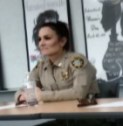
Captain Andrea Taylor

Captain Andrea Taylor has been commander for 16 years of the South Valley Area.  She received her bachelors from UNM in criminology and has a master’s in forensic psychology, working on another master’s in mental health counseling.

She started in 2001 on patrol, then promoted to detective rank where she worked undercover narcotics for five years where her specialty was cartels and methamphetamine and was the only woman working undercover in the state of NM.  In 2014 she was promoted to the captain of criminal investigations unit.

She also created the world’s first Animal Cruelty Task Force that goes out street by street looking for animal abuse.  This program has now taken off across America. “It combines my passion for animals with my passion for Law Enforcement,” she said.

iyer.jpg
Srividya Iyer

Srividya Iyer is a part time instructor at CNM, currently teaching Linux Essentials, which she said currently only has two women out of twenty students. She is an electrical engineer and has been an engineer for 20 years.   She has her own company, Caniv Tech, which does network analytics with funding from the National Science Foundation, for customers in the private and government sector.  She also does a lot of mentoring for high school and middle school students who are interested in going into the STEM field.

She said she grew up in India and came to the United States for graduate school.  What really made her interested in engineering was a physics teacher she had in high school.  “He really brought physics to life; otherwise they would just make us memorize things.  I never realized how creative one could be; he is the one who made me want to get into this field.”

White
Captain Jackie Lance-White

Albuquerque Fire Department Captain Jackie Lance-White grew up in Canada and attended a junior college before attending UNM on a softball scholarship.  She later went on to compete with the Canadian Olympic team for softball in 2000 and 2004.

At 27 she thought about being a cop, but didn’t qualify because of her Canadian citizenship, so she applied for the Fire Department.  She also attended paramedic’s school.

She highly recommends the CNM EMT class because she said about 80% of her job is medical like heart attacks and car accidents.  She taught at the academy for a little while and then went on to work in the Arson Investigation Division as Captain where she works with firefighters from both county and city departments.

She is also in post grad school with the Navy working on her Masters in Homeland Security.

SWOP raises APD awareness

By Jonathan Baca, Copy Editor | Photo by Moises Gonzales

swop

On April 9, the Department of Justice released their report on the use of excessive force by officers of the Albuquerque Police Department from 2009 to 2013, finding that APD has shown a pattern of regularly violating citizen’s Constitutional rights due to “insufficient oversight, inadequate training, and ineffective policies.”

The report also found that officers used non-lethal force too frequently, that poor training and reckless actions by police actually created the need for force in many instances, and that a sig­nificant number of incidents involved people with mental illnesses.

Former student Rodrigo Rodriguez, who works as an organizer for the Southwest Organizing Project (SWOP), said that his and many other community groups have been working to support efforts to raise awareness of the realities of police violence, and to hold the APD and the city accountable.

“Community organizations like SWOP recog­nize the passion and the energy around this issue, and are more willing and able to make themselves available as resources through the community,” Rodriguez said.

SWOP is a grassroots organization working to fight social injustice through different campaigns, and they have been helping to organize protests, support the families of victims, and encouraging members of the community to get involved in the issue of police brutality, Rodriguez said.

The DOJ report contained a lengthy list of recommendations, including major changes to APD’s policies regarding the use of force, dealing with mentally ill people, de-escalation training, less emphasis on weapons and tac­tical training and more focus on community outreach and building partnerships with out­side groups.

George Lujan, Communications Organizer for SWOP, said that while the report’s recommenda­tions are a step in the right direction, the real solu­tions have to come from the citizens of Albuquerque.

“We don’t expect any federal entity or anyone else to show up in Albuquerque and clean up our mess. I think we all have to figure out what those solutions are, and it starts with the community,” Lujan said.

SWOP has been hosting an ongoing storyteller series about different issues like food justice and women’s issues, and their next event is scheduled for April 25 at the Albuquerque Center for Peace and Justice, where they will be discussing the city’s history of police violence, and the legacy of activism and resistance against it, Rodriguez said.

Lujan said that the issue is about a lot more than an out of control police force— the problems extend to every part of our community, and the solution will require that everyone looks at how the community treats some of its most vulnerable members.

“It’s about the entire community: eradicat­ing poverty and giving people proper healthcare, making sure that we have mental and behavioral health services, making sure people know their rights, and getting away from the culture of milita­rization that our police is so wrapped up in. It’s not just the DOJ and APD, it’s much more complex,” Lujan said.

Mayor Richard Berry said in a press release that he acknowledges the problems in the APD, and that he is willing to continue working with the DOJ in implementing the changes that they sug­gested in their report.

“I’m of the opinion that when the city is bang­ing at your doorstep and you’re the highest elected official, you need to show up, even if it’s just to save face. It was really disappointing to see that he didn’t show up to what was probably the most important council meeting of his tenure,” Rodriguez said.

Whatever happens, Lujan said that SWOP will keep working with community mem­bers and other groups to make sure that changes are made, and that Albuquerque residents stay engaged and active.

No one can truly fix these problems but the people, he said, and the solutions will involve much more than Federal oversight and police reforms.

“I do believe that it’s going to be New Mexicans that are going to create the change here, not any outside groups. We need to really figure out how we’re taking care of people and at—risk communities in our society, and I think that when we start answering those questions we’re going to see positive outcomes,” Lujan said.

Suncat Chit Chat; Issue 40 Volume 19

By Carol Woodland, Staff Reporter | Photos by Carol Woodland
How did you react to the Albuquerque Police Department report from the Department of Justice released on Thursday, April 10?

Kishin Swenson, Political Science major “I want to see a citizen’s oversight committee that doesn’t need to go through the mayor or the police chief to fire or prevent the hiring of any police officer. There’s a culture of violence and the shootings are just the tip of the iceberg. I understand it’s a tough job, but they can’t go into it with the mindset of destroying evil; the easiest way to become evil is to label something as evil and attack it.”
Kishin Swenson, Political
Science major
“I want to see a citizen’s oversight
committee that doesn’t need to go
through the mayor or the police
chief to fire or prevent the hiring of
any police officer. There’s a culture
of violence and the shootings are just
the tip of the iceberg. I understand
it’s a tough job, but they can’t go into
it with the mindset of destroying evil;
the easiest way to become evil is to
label something as evil and attack it.”

Julian Sierra, EMT major “Their job is to protect and serve and they’re not doing that. I’m afraid to call the cops. If someone gets robbed, I don’t even know if I want to call the cops because they might think that I robbed the house.”
Julian Sierra, EMT major
“Their job is to protect and serve and they’re not doing that. I’m
afraid to call the cops. If someone gets robbed, I don’t even know
if I want to call the cops because they might think that I robbed
the house.”

James Newman, Engineering major “They’ve got this military mentality, their job isn’t to go to war with the citizens, their job is to ensure the peace. You don’t do that by shooting people, there’s other methods.”
James Newman, Engineering major
“They’ve got this military mentality, their job
isn’t to go to war with the citizens, their job is to
ensure the peace. You don’t do that by shooting
people, there’s other methods.”

Cody Montoya-Harris (left), Pre-Nursing major “I think it’s great that they’re investigating. With everybody watching, with the recent story of the shooting, it’s important for people to protest responsibly because everybody’s watching. You can’t protest violence with violence. If it’s done right, it can set the stage for other cities doing right too, everybody’s watching.”
Cody Montoya-Harris (left), Pre-Nursing major
“I think it’s great that they’re investigating. With everybody
watching, with the recent story of the shooting, it’s important for
people to protest responsibly because everybody’s watching. You
can’t protest violence with violence. If it’s done right, it can set
the stage for other cities doing right too, everybody’s watching.”

Brandon Jones, Network Administration major “I’m glad that the DOJ came in and did what they had to do, I think that was the first step. My major issue with APD is when something like this happens, no one gets fired; it’s been a repeating problem. Start making examples out of people, fire people. They need to start making examples out of bad cops.” “I understand that APD has a hard job, that’s not an easy job to begin with, but they need to start making examples out of cops that make bad decisions.” “It’s a sad situation and it needs to be dealt with. People that are bad cops need to be dealt with and they need to lose their jobs and make examples out of them.”
Brandon Jones, Network Administration major
“I’m glad that the DOJ came in and did what they had to do, I think that was the first
step. My major issue with APD is when something like this happens, no one gets fired;
it’s been a repeating problem. Start making examples out of people, fire people. They
need to start making examples out of bad cops.”
“I understand that APD has a hard job, that’s not an easy job to begin with, but they
need to start making examples out of cops that make bad decisions.”
“It’s a sad situation and it needs to be dealt with. People that are bad cops need to be
dealt with and they need to lose their jobs and make examples out of them.”

APD protests spark controversy among community

By Rene Thompson, Editor in Chief | Photos by Rene Thompson

4.3

4.1

Demonstrators took to the streets on Tuesday, March 25 and Sunday, March 30 to protest against the Albuquerque Police Department’s use of force and killing of Albuquerque citizens.

Specifically James Boyd, who was shot and killed while squatting in the Northeast Heights Foot Hills at Copper Trailhead, on March 16, and protests eventually ended in people being dispersed by tear gas at Girard Blvd and Central Avenue and at APD head­quarters twelve hours after protests began on Sunday.

Since the first protest on Tuesday that brought more than 1,000 people to the event, there has been a massive media frenzy online and many took to the internet on social media sites to voice their concerns, whether people were in support of APD or against APD’s use of force.

Former student and Activist with the ANSWER Coalition, Joel Gallegos said that this whole situation had blown up because it had been a long time coming and that the city should not be surprised by the blowback that occurred in the pro­test event on Sunday.

ANSWER stands for Act Now to Stop War and End Racism, but also helps with organizing many protest events through­out Albuquerque, and Gallegos said that is why the ANSWER coalition is around, to give people the opportunity to participate in a safe way that is organized.

“The police were wrong to escalate the situation with a paramilitary response,” Gallegos said.

Gallegos said that whether it is direct action, civil disobedience, or politi­cal action, that the coalition wants to encourage folks to get involved.

History major, Zachary Case, who was at the Sunday event earlier in the day to observe protesters, said that he never saw protesting as a real way to change anything.

Case said that there were many touching stories at the event from people who had lost loved ones to police violence.

“I love freedom of speech and freedom of assembly; it’s just not exactly certain what will happen from all this,” he said.

Former President of ECOs, Stephen Martos said he believes people should be supporting APD instead of protesting them, because the police force is an essen­tial part of the community.

Martos said that APD is necessary to serve and pro­tect, but that there are times when that does not always ring true, as in the recent officer involved shooting.

“You cannot improve the situations by creating enemies, but instead by making partners. We are partners with our police force and are responsible for bringing our community together,” Martos said.

The Department of Justice has had an ongoing investigation of APD since Nov. 2012, after numerous misconduct lawsuits had cost Albuquerque taxpayers more than 24 million dollars in 2010 alone, according to a justice.gov D.O.J. press release and the Albuquerque Journal.

APD has been dealing with threats and personal infor­mation of officers being leaked from the activist and hacking group Anonymous, as APD’s website was attacked on Sunday which kept their site down for most of the day, Police Spokesman, Simon Drobik said in a statement.

Gallegos said that politicians do not start talking about prob­lems until the people make it a problem.

He also said there is a city ordinance that allows protesters to march in the streets without a specific permit.

“We can’t control what others do, and we might not agree with the tactics used Sunday night but we fully support and stand with the people involved,” he said.

Case said that police should not be militarized— period, and that the city is just trying to control the population instead of pro­tecting them.

Case said that he believes that if a cop is going to assault someone, then that person should have the right to defend themselves.

“This has been going on in Albuquerque since I was a little kid, and I remember there being issues of police brutality in our city since then,” he said.

Martos said that he believes that there are two camps of people protesting, with those that are truly interested in improving the APD, and those who are only interested in stirring the waters, because they are only focused on negativity.

It is necessary to alert our lawmakers and those administering training in order to improve in the ways we are failing, but Martos said that some of these pro­testers have lost sight of what the real issue is, which is the excessive force of APD.

“What is sad is they have done this in the name of James Boyd whom nobody worried about before he died. If the community cared so much, then they would have been out there helping him with food, water, shelter and healthcare,” Martos said.

According to justice.org, the Violent Crime Control and Law Enforcement Act of 1994 prohibits state and local governments from engaging in a pattern or practice of misconduct by law enforce­ment officers that deprives individuals of federally-pro­tected rights.