Man on a Mission

Story and Photos by Mark Graven

Staff Writer


The eastbound 97 bus rolled into the bus stop by CNM ‘s Jeanette Stromberg Hall, and deposited one passenger–and his bike.
The passenger was Lance Wilson, a CNM Aviation Technology major.  “I was having trouble registering for classes, so I decided to come over and see what I could do in person,” explained Wilson.
As he gathered his belongings and prepared to mount his bicycle on this sunny, hot July afternoon, Wilson, 38, said he sees education as a path to a “good job.”
A native of Los Lunas, said he did not graduate from high school, but stuck with his education, and got his GED in 2012.  He recently used his stimulus check to get his education back on track at CNM, he said.
Wilson said he is able to get around Albuquerque fine by bike and bus, and that he is a strong bike rider.
“Lance Armstrong is Lance ARMstrong” he said, with emphasis.  I am Lance ALLstrong.”

DUCK POND BACK UP

Photos by

Mark Graven

Staff Writer


The iconic UNM Duck Pond is back up and running after a 10-day cleaning project that involved draining down the pond.  On Thursday, July 16th, ducks were spreading their wings, splashing, and diving, in their refreshed water, as turtles sunned themselves on the pond rocks.  Fish were temporarily removed during the cleaning project, according to university officials. Now everything is proceeding swimmingly.

Who Was Joseph M. Montoya (Montoya Campus)

Story and Photos

By Mark Graven, Staff Reporter

The Joseph M. Montoya Campus of CNM, nestled in the foothills of the Sandia mountains, is quiet these days, which is probably not the way its namesake, Senator Joseph Montoya (1915-1978), would like it, said his daughter, Lynda Montoya Haran.

Of all the issues he worked on, education was his number one priority, said Haran, now in her seventies, interviewed by the CNM Chronicle via phone from her home in Basking Ridge, New Jersey.

“My father viewed education as a pathway from a bad life to a good life,” said Haran. “And he believed that everybody, whether they be in a profession, or a trade, should have the opportunity to get an education.”

CNM’s Joseph M. Montoya Campus-Stairway to a hands on education.

She noted that her father was a sponsor of legislation that strengthened vocational education in the United States, through the Community College system, and provided a means of accreditation for such schools. 

Haran said her father was a strong consumer safety advocate, who would undoubted be concerned about the health and safety of students as they pursue their education.

In fact, she said, her father and then Senator, (and later Vice -President) Walter F. Mondale of Minnesota were the chief advocates of the Wholesome Meat in 1967 that gave the Federal government the authority to regulate state meat processing facilities under federal guidelines to protect consumers.

Haran called the Montoya campus–located off Morris Avenue in Northeast Albuquerque, which opened in September of 1979– a “very fitting” memorial to her father, who grew up poor and advanced through education.

“He knew at the age of 10 or 11 that he wanted to go into politics,” she said.  “A graduate of Bernalillo High School, Montoya went on to receive a bachelor’s degree from Regis college in Denver, and a law degree from Georgetown University in Washington.

It was during a summer off from law school that Montoya returned to New Mexico to run for seat in the State House of Representatives.  He won, but had to wait until he turned 21, to be sworn in, according to Haran, adding he was the youngest to serve in that post—which became a pattern in his career.

He was also the youngest to serve as a State Senator, in 1946, and as Lieutenant Governor in 1947, she said. Montoya was elected to the U.S. House of Representatives in 1957 and moved up to the U.S. Senate in 1964, where he served until 1977. Part of his tenure involved serving on the Senate Watergate Committee, in another turbulent time for the country.

Montoya lost a bid for re-election in 1976 even though he was slated to become Chairman of the Appropriations Committee, Haran said.

He died of kidney and liver problems at the age of 62, in June of 1978, so he was not able to see the opening of the campus named in his honor in 1979.

It was as a member of the House, that Montoya co-sponsored the Vocational Education Act of 1963, which gave a big boost to accredited education in trades with funding for programs  (including work-study) and facilities, and boosted the prospects for community colleges generally, according to Haran.

Haran said the beauty of the facilities and grounds at the Montoya campus impressed her, when she attended the 25th anniversary of opening of the campus in 2004.

“BEAUTIFUL” BACKDROP– For  CNM’s Joseph  M. Montoya Campus– the Sandia Mountains

The Montoya campus features courses in business, computers, cosmetology, and dental, and hosts an art studio, and chemistry lab, among other things.

During the challenge of the Coronavirus, the campus has been largely dormant, except for maintenance activities.

“It is a beautiful campus,” noted Haran. “I want to see it again, and this time bring my son.

Haran said she herself graduated from Trinity Washington University, in Washington, D.C., after which she became an assistant editor at Look Magazine’s Washington Bureau.

Haran said that one of the highlights of her days in Washington was attending a barbecue at the office of Senator Robert Kennedy.

“My Dad and Senator Kennedy were in the same freshmen class of the Senate (1964). Senator Kennedy,” she said, “invited all the kids from the senators of that class to the barbecue. They cooked the hamburgers in the fireplace Bobby had in his office, Haran recalled.”

It was just a little more than a year earlier that a young Haran had been one of the mourners who filed past the casket of the slain President John F. Kennedy, in the U.S. capital rotunda–a reminder that the nation has been through bad times before and gotten through them.

“Hopefully, we can get through these horrible times, and move forward,” said Haran.

Virtual Graduation: A Success, Learning Experience For All Involved

by Enjoly Gutierrez

Staff Reporter 

CNM conducted its first-ever on-line virtual graduation on May 2nd, said Dean of Students, Christopher Cavazos, 

There were 611 students that registered for CNM virtual graduation that consisted of 5 videos that students would click through with different speakers including Vice President of Student Services Eugene Padilla, President of ECOS Angel Garcia and CNM President Tracy Hartzler, he said.

Below the video there was a presentation of the names of students that had graduated that could be clicked through, he said.

“I think it went well despite the fact that we had little time to put everything together,” Cavazos said.

General Business Certificate Graduate, Downa Preston, said, The presentation would have been a lot easier to go through if it had all be in alphabetical order instead of separate sections of an alphabetical list.

“I think it went okay the only problem was they should have had the videos labeled better because we ended up skipping to the very end before they read all the names or before all the names were read out so that was a little confusing,” she said.

Cavasos said, he would have liked more coordination when recording the videos for virtual graduation.

CNM had to find a vendor to help create the virtual graduation program that would allow this process to take place, he said. 

Although ideally in person graduations would resume soon, Cavazos indicated that he would do this type of graduation again if needed.

Preston said, that she thinks that they should continue virtual graduation alongside in-person graduation because it could be helpful in the situation that the country is currently in with the whole COVID-19 but it can also help when students are across the country or have family scattered across the country and they are unable to attend a traditional graduation.

“I had not planned to attend graduation but due to it being offered online I went ahead and did it since I didn’t have to buy the cap and gown,” she said.

Cavasos said that by Monday, May 18th there were over 2373 views of the CNM virtual graduation and if anyone wants to view it, they can see it here.

Peace and Justice

By Staff Reporter

Mark Graven

The Albuquerque Peace and Justice Center may be closed today because of the corona virus situation, but the struggle for peace and justice continues, according to Jim Harvey, the PJ   Center’s director.          

Located just a few blocks from the CNM campus at 202 Harvard Street, Southeast, the center is conveniently located for CNM Students who want to engage in the struggle. The PJ Center is temporarily closed, however, until April 30th, in keeping with the recommendations of city and state officials, according to Harvey, who is just a few months into his job.

The PJ center generally provides meeting space and resources for some 75 “PAJOLA” (Peace and Justice Organizations Linking Arms) members. A full list of the PJ Center’s members is available on its website—abqpeaceandjustice.org

“Our PAJOLA members are scrambling to keep things going by meeting via Zoom, or Skype,” said Harvey.  “We also have our electronic newsletters, which people can access on our website.”

Meanwhile, one PAJOLA group—Good Food Distribution is keeping a decade-old tradition of distributing food to folks in need, in the PJ Center’s parking lot. Distribution is set for Saturdays, 9 a.m. to 11 a.m., according to Molly Wilkie, a “point-person” for the group. 

Wilkie said in a phone interview  that Good Food is getting   donations by such stores as Costco and Whole Foods. She said volunteers distributing the food would be wearing masks and gloves, and practicing social distancing.

Harvey said that because of the role Peace and Justice plays in the community, and the clientele it serves, his inclination was to stay open as long as possible. At first city officials agreed. But as the pandemic seemed to be growing more serious, the position of city officials changed, and that the center is cooperating.

Harvey,75, has been committed justice movement for the long haul. A Chicago native, he joined the Student Non-Violent Coordinating Committee at the age of 15. He got to meet and or work with such civil rights luminaries as

Reverend Dr. Martin Luther King, Jr., Bayard Rustin, Malcom X, and John Lewis (former head of Student Nonviolent Coordinating Committee, and now a U. S. Congressman from Georgia)

Harvey said he appreciated Dr. King’s devotion to non-violence.

“I lean to non-violence, always,” said Harvey.  “But you also have to defend yourself against violence.  Laying down your life, without defending yourself, is not where it’s at.” 

He said that his personal philosophy was a bit of Dr. King and a bit of Malcom X.  He said that he thought Malcolm X was wrongly perceived  as a proponent of violence, when he was actually advocating a right to self defense, which made him a proponent  of justice. 

‘’We want peace, Harvey noted, ”but justice comes first.”

On the night Dr. Was assassinated in Memphis, Tennessee ( April 4, 1968), Harvey said that he and some friends were visiting jass musician and composer, Alice Coltrane, the widow of Jazz great John Coltrane, in New York City. On a taxi ride that got him only part-way home, he could see that Harlem was already ablaze at the news of the assassination .

King’s death marked a new phase in the civil rights movement, according to Harvey.  It went from securing basic rights for blacks in the South to addressing economic injustices in the North.

Harvey said he views Bayard Rustin, a close advisor to Dr.King as a key planner of the movement.  He was a very competent strategist,” said Harvey. 

Both Dr King and Malcolm X took a big-picture view of civil rights, according to Harvey.  By the time he was killed, Dr. King had become a major critic of the Vietnam War, and was addressing the plight of the Vietnamese people. Malcom X’s work and travels opened his eyes to various types of oppression around the globe, according to Harvey.

Harvey said that at this time, he is concerned about racist attacks on Asians, because the corona virus is said to have originated in China.

“I am concerned that people of Asian descent are being targeted, and we have to speak out for them,” said Harvey.

New Max Salazar Hall To Be A Technological First In New Mexico

Story & photos by Staff Reporter

Chloe Fox

The exterior of Max Salazar hall on December 5th, 2019

According to project manager Peter Siebert, the renovated Max Salazar hall features improvements such as added ‘agility spaces’, which Siebert said are equipped with various features such as adjustable color mood lighting, intended to help carve out spaces for students to be productive and comfortable at the same time.

One of the ‘agility spaces’ mentioned by Siebert to help improve the overall student experience in Max Salazar.

Siebert said that an emphasis on improving the technology in the building was at the forefront of the project. A new wifi network, televisions, LED lighting, and self-filtering windows are a small portion of what has been added to the space.

An example of the new LED lighting systems, showcased in an agility space.
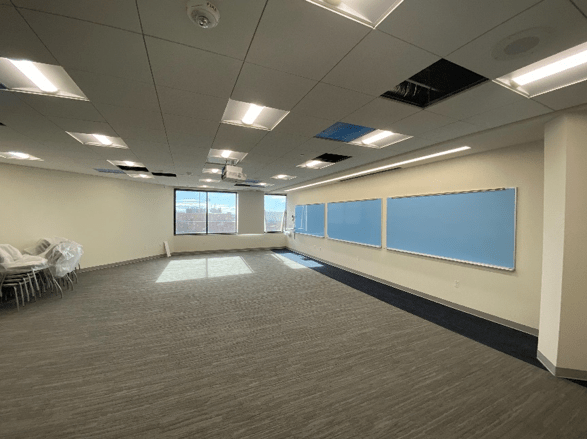
A completed 4th floor classroom.

Siebert said that one of the new technological features is the electrochromic windows, which automatically tint throughout the day and give full control to instructors of the amount of light filtering into their classrooms.

CNM is one of the first schools in New Mexico to utilize this technology in the classroom setting, he said.

An additional view of a completed 4th floor classroom.

In terms of inclusivity, Siebert said they’ve added two new single stall bathrooms to each floor in order to help students and faculty feel more comfortable.

A new classroom, part of the front expansion of Max Salazar. This classroom features the new electrochromic windows.

The administration and faculty spaces on the 5th floor are being completely renovated, Siebert said.

There will be more collaborative spaces for students and faculty alike, and there has been an emphasis on improving natural light in those spaces, he said.

[adrotate banner="2"] AD

A new reception desk will help students and faculty locate whomever they need to get in touch with, said Siebert.

The new reception desk in the administration and faculty offices located on the 5th floor
The new lobby in the administration and faculty offices on the 5th floor.
Additional student/faculty meeting spaces on the 5th floor of Max Salazar.
The new addition to the front of Max Salazar hall includes all new classrooms, set to open a few months after the rest of the Max Salazar project according to Siebert.

Siebert said the building was built in 1991, which means a gut renovation was required in order to bring in the necessary improvements.

New sustainability efforts have been put in place including exterior telescoping solar arrays which move with the sun, all new LED lighting systems, as well as new meters for all utility usage in order to monitor the building’s consumption and using all LEED certified materials for construction, said Siebert.

On to The Next, How Time Flies

By Daniel Johnson, Editor In Chief

2019 had over 550 balloons, 886,307 attendees, and 650 pilots from across the globe.

It was another great year for the Albuquerque Balloon Fiesta but it is officially time to move on to the next.

Scheduled to take place from October 3rd to the 11th in 2020 the theme for the upcoming years Fiesta is Timeflies.

Let’s take this opportunity to look back at some of the fun from 2019 as we look forward to Balloon Fiesta 2020.

New Q-Community Resources in the Fall

Story by Audrey Callaway Scherer, staff reporter

Multiple new resources have been scheduled to begin this fall for CNM’s LGBTQ+ community and allies, including weekly lunch socials, another Coming Out Day, regular visits for HIV testing on campus and the chartering of a new student group, said Brian Rasmussen, an organizer of QCNM and the LGBTQ+ Advisory Committee at CNM.

These new resources and activities are a continuation of the two groups’ collaboration to create more equity and safe spaces for people and allies in the LGBTQ+ community, he said.

“One of the ways we wanted to start creating more equity was to raise visibility . . . so that people would see that CNM is an inclusive place – for the most part, there’s lots of places that we need to keep working on – and that there are people in the institution who are actively working to change policies to create a safer and more welcome environment,” said Rasmussen.

Weekly lunches will be replacing the Q-Study Halls that have been active since the spring term of 2018 but not getting the attendance the organizers had hoped, he said.

The lunches, much like the study halls, will provide opportunities for people to drop in, hang out, socialize and get to know each other every Wednesday in the Main Campus cafeteria. It is also confirmed that the event will take place at the West Side and Montoya campuses, he said.

QCNM will also be hosting its second Coming Out Day in October of 2019. Because the group’s focus is on getting the student group running, he said this year will be scaled back a bit, but last year, they had food, a speakers’ panel and people tabling from many different organizations.

On June 27, for National HIV Testing Day, free HIV testing was scheduled to make its first appearance on Main Campus through Southwest Cares, an organization that provides free HIV and sexually transmitted disease testing for people, he said. The visits are to be similar to blood bank visits as they will just be on campus if anyone wants to get their status checked.

After this first visit, he said the committee plans to have them on campus either monthly or every other month.

QCNM may also try to get a group together to do the HIV walk in September as an institution to help Albuquerque Pride raise money for HIV research, he said.

The student group, Q-Cats, has been scheduled to be chartered in August and will be the third level added to the administration-centered advisory committee and the more social, all-inclusive QCNM.

“The student group will be whatever it wants to create,” said Rasmussen. “There will be a lot of cross-pollination between the three different levels, so that people are working with each other across the different levels in the institution.”

Some of the activities that are discussed between the three groups during QCNM meetings will be turned over to the Q-Cats for handling, he said.

QCNM meetings typically happen monthly and allow people from all different sectors – students, faculty and staff – to create a safe space and talk about what is going on around the school, the issues that need to be addressed, what the institution should be doing and what they would like to do, he said.

“What are some of the fun things we can do to create community on campus, to give people role models, to create networking?” he said.

Part of getting the Q-Cats active is to get them able to do tabling, which is basically setting up a table to provide people with information, answer questions and refer to allies in the community when they don’t have the answers, he said.

QCNM has assembled a kit that includes all kinds of tabling things, such as brochures, flyers, candy and rainbow tablecloths, that a student, faculty or staff member would be able to use for events they have requested or set up.

Those doing tabling would also refer people to CNM’s resources, such as the lgbtq@cnm.edu email address, the QCNM Facebook page, or the QCNM website – http://www.cnm.edu/student-resources/lgbtq, he said.

The Facebook page has a lot of content and the website has a lot of resources, including an Ally List and access to a discrimination and complaint process, he noted. QCNM also has a listserv, which is qcnm@cnm.edu.

“There’s so many things we’ve been working on,” he said.

QCNM and the committee have worked with various departments at CNM to change policies around name changes, make sure that almost all the buildings on the campuses have gender-neutral bathrooms, and provide Safe Zone, Trans 101 and Trans 201 trainings for faculty and staff, he said.

In addition, they have done community service types of events and events on campus.

They have set up volunteer days at Roadrunner Food Bank during which they helped for a few hours in the back, sorted, organized and shelved food or did whatever needed to be done, he said.

On campus, they have done a movie night and welcome back mixer. Off campus, they have gone to the Isotopes games a couple times and planned a Cliff’s Amusement Park day.

“Just showing up as a group,” he said. “Like, ‘Hey, let’s all go do this fun thing together.’”

The events are not exclusive and anyone is welcome, he said. Although, he noted, sometimes in creating a safe space, the needs of the minority community must be prioritized.

Pending approval, they would eventually like to try a rainbow graduation activity such as a small reception before the ceremony celebrating the success of the LGBTQ+ group for graduating and maybe giving them rainbow cords, a button or something they could wear, he said.

QCNM and the advisory committee have worked with multiple organizations in the community, most of which can be found on the school’s LGBTQ+ online resource page – http://www.cnm.edu/student-resources/lgbtq/resources.

They have also worked a bit with American Veterans for Equal Rights (AVER), the New Mexico Faith Coalition for Immigrant Justice, Albuquerque Pride and the people helping the transgender people at the Cibola Detention Center, he said.

QCNM started in May of 2017 and the LGBTQ+ Advisory Committee started in February of 2018 in response to the Orlando shooting and Erica Barreiro Volkers, the dean of the School of Communication, Humanities and Social Sciences, took the lead, he said.

The group was organized to compare CNM to other institutions through a campus index and then think about what the school should be doing. The whole first year was mostly planning, he said, but things really took off after that initial meeting.

“We’ve had a really effective group of people in getting a lot of stuff done,” he said. “It’s really exciting to think, in my not even three years, like two and some months, of all the things we’ve effected on the individual student level but also on the systemic institutional level. And more good stuff coming.”

Rasmussen’s full-time position at CNM is as a staff sign language interpreter for the Disability Resource Center and the rest of what he does are basically projects that he has taken up, he said.

“My supervisors have been really kind to support it and they see that it’s a need,” he said. “As long as my work gets done, I can do this on the side.”