New Max Salazar Hall To Be A Technological First In New Mexico

Story & photos by Staff Reporter

Chloe Fox

The exterior of Max Salazar hall on December 5th, 2019

According to project manager Peter Siebert, the renovated Max Salazar hall features improvements such as added ‘agility spaces’, which Siebert said are equipped with various features such as adjustable color mood lighting, intended to help carve out spaces for students to be productive and comfortable at the same time.

One of the ‘agility spaces’ mentioned by Siebert to help improve the overall student experience in Max Salazar.

Siebert said that an emphasis on improving the technology in the building was at the forefront of the project. A new wifi network, televisions, LED lighting, and self-filtering windows are a small portion of what has been added to the space.

An example of the new LED lighting systems, showcased in an agility space.
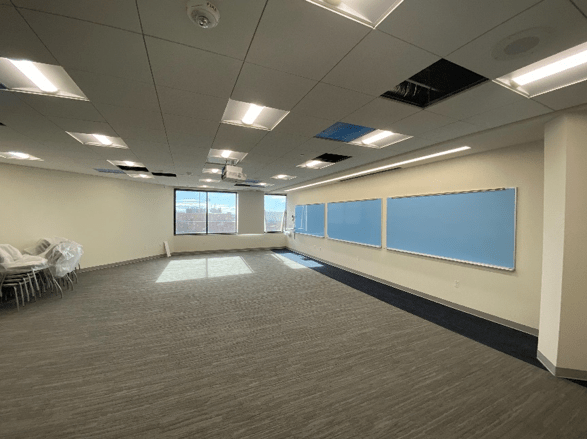
A completed 4th floor classroom.

Siebert said that one of the new technological features is the electrochromic windows, which automatically tint throughout the day and give full control to instructors of the amount of light filtering into their classrooms.

CNM is one of the first schools in New Mexico to utilize this technology in the classroom setting, he said.

An additional view of a completed 4th floor classroom.

In terms of inclusivity, Siebert said they’ve added two new single stall bathrooms to each floor in order to help students and faculty feel more comfortable.

A new classroom, part of the front expansion of Max Salazar. This classroom features the new electrochromic windows.

The administration and faculty spaces on the 5th floor are being completely renovated, Siebert said.

There will be more collaborative spaces for students and faculty alike, and there has been an emphasis on improving natural light in those spaces, he said.

[adrotate banner="2"] AD

A new reception desk will help students and faculty locate whomever they need to get in touch with, said Siebert.

The new reception desk in the administration and faculty offices located on the 5th floor
The new lobby in the administration and faculty offices on the 5th floor.
Additional student/faculty meeting spaces on the 5th floor of Max Salazar.
The new addition to the front of Max Salazar hall includes all new classrooms, set to open a few months after the rest of the Max Salazar project according to Siebert.

Siebert said the building was built in 1991, which means a gut renovation was required in order to bring in the necessary improvements.

New sustainability efforts have been put in place including exterior telescoping solar arrays which move with the sun, all new LED lighting systems, as well as new meters for all utility usage in order to monitor the building’s consumption and using all LEED certified materials for construction, said Siebert.

Student to Student Advice

Staff Reporter and Photographer Erin McRoy

College isn’t that hard, said former CNM student Rhiannon Salas, if students know how to navigate the website, academics, and the resources available to them.

Salas said the classes at CNM are smaller making it an easier transition from high school to college.

Rhiannon Salas, former CNM Student

“It’s not as scary as you think it’ll be,” said Salas. “In high school they make it seem like this super scary moment and it’s going to be the hardest thing ever and your professors are going to be completely evil—it’s not like that.”

Incoming students should know that their education can be largely covered by filling out the FAFSA, according to Salas who paid for her first year through Grants and the Lottery scholarship.

Students should always fill out the FAFSA, because they may qualify for more than they thought, said Salas, commenting, “You’re giving me money? I get this? Cool.”

The FAFSA requires parental tax information which can impact a student’s aid eligibility, said Salas who had to get into her savings account one year because her mother had gotten a bonus.

She was told, “You make too much money. It was one bonus! I had savings so it was fine, but what do you mean I don’t get that? I’m not rich.”

Salas recommended staying away from student loans if possible, because so many people owe the government for their education and have trouble paying that money back.

Classes fill up quickly, limiting options for times and locations, which is why Salas recommended registering for classes as soon as possible.

“Literally, the second you can is the best time to register for classes,” she said.

According to Salas this ensures students get the classes they need at the times they want, but it also means that students have time to changes schedules if necessary.

Salas didn’t know that the library offered laptops to rent for students and admits that she would have liked to know more about the resources available for students at CNM.

She said she considered work study, but didn’t know where to get information about applying and would like to see that made clearer to students.

Students interested in work study should check with financial aid and CNM careers for more information, said Salas.

Wait before purchasing your school textbooks until the first week of class, said Salas, since most professors won’t expect students to have their books until financial aid kicks in.

“Chegg is awesome. Why? Because you can rent your books used and it’s super cheap! Cheaper than renting from the Bookstore,” said Salas.

Salas admitted that sometimes students have to buy from the Bookstore and they can use financial aid there to purchase school supplies, but if students can shop elsewhere it would be cheaper.

Every student should have at least a pencil and a notebook at the minimum for class, she said.

Salas said while not every student needs a laptop, school isn’t doable without a computer anymore.

“You don’t have to have a fancy laptop or anything, why, because that’s what the library’s for. You can go use their computers,” she said.

For those students planning to drive to school, Salas said to get there early enough to find parking because the general parking lot fills up quickly and students may have to walk a ways to get to their classes.

Even if students arrive an hour or so before their class, there are plenty of places inside to sit, and at least students will have a parking spot, said Salas.

“Even if it’s a bad parking place, at least you got to park somewhere,” she said.

When Salas first started at CNM, she didn’t know what she wanted to major in and went to an advisor for help.

She admitted that her encounters meeting with advisors were very helpful, but not everyone has the same experience.

When meeting with an advisor, Salas urged students to have specific questions in mind and to meet with the same advisor if possible.

“I guess, you never know, you don’t know what you’re going to get. Maybe that’s the key. Maybe you should just consistently try to shoot for the same advisor,” said Salas.

Salas encouraged students to get familiar with Degree Works to track their progress and to do research online about what resources are available.

CNM RESOURCE LINKS

CNM Job/Career Search: https://cnm.csod.com/ats/careersite/search.aspx?site=4&c=cnm

CNM Financial Aid Student Employment: https://www.cnm.edu/depts/financial-aid/student-employment/apply-for-student-employment

CNM Maps (multiple campuses): https://devplone5.cnm.edu/campuses

The Psychology Behind Cuffing Season

Story and pictures by E.C. McRoy, Staff Reporter

Trent Toulouse, professor of psychology, said that there may be biology behind Cuffing Season.

He said that people are biologically more likely to have summer babies, because there would be a better chance for survival which means humans are more likely to get together in the winter.

Although people now have options to avoid pregnancy their minds have been wired to relate relationships with babies, he said.

People may not consciously think of why they want to be with someone in the winter, but biology may still be shaping people’s decisions, Toulouse said.

Dennis Escovedo, culinary arts major, suggests that people are going to do what they want no matter what the season is.

“Everyone’s brain is different, everyone thinks different,” said Escovedo.

Anthony Gonzales, electrical engineering major, doesn’t give much credit to the idea of a cuffing season, because the decisions people make are based on the individual and that person’s mentality.

School takes priority for Gonzales and keeps him from being depressed even though he isn’t in a relationship, he said.

“If I were in a relationship I would be depressed,” he said, because he would then have to split responsibilities between a relationship and school.

Rie Bailey, biology major, suggested that it could be the term itself causing cuffing season and does not see why there needs to be a name at all.

“The words itself are weird. Like, hand-cuffing? Stuck with someone season?” said Bailey.

Savannah Sandoval, psychology major, agreed that the term makes it seem like a relationship is a bad thing but argues that the individual decides if he or she wants to be stuck with someone.

Socially, people spend more time indoors during the cold months and there are the holidays, too, Professor Toulouse said.

According to Gonzales, the holidays are when everyone gets together, so there should not be a reason to be depressed or lonely and even those without family have friends to lean on.

“We don’t think of anything else, we just think of each other,” said Gonzales.

Escovedo said that if there are people and family surrounding a person then there should not be that pressure to be in a relationship.

Sometimes being in a relationship can take a person away from family, said Escovedo.

He said that people do not want to be alone on the holidays and those without family might make decisions based on this.

Sandoval said it likely has to do with the holidays, “You’re surrounded by family and how many of your family members have someone? And everyone’s always asking you when are you going to get someone, too.”

Both Bailey and Sandoval agreed that the end of the season could be caused by the pressure of Valentine’s Day and the expectations of the holiday.

Escovedo said that if people are together for a certain amount of time they are likely to develop deeper feelings for each other and a scheduled end of the relationship might change.

There may be seasonal mood shifts like depression and anxiety that are due to changes in the weather and how much sunlight people get, Toulouse said.

These changes have to do with a decrease in the naturally occurring chemicals that make us feel good and new relationships can produce some of the same things that make us feel good, he said.

Toulouse said more research would need to be done to reach a conclusion and suggests looking at a country with the same holidays but in the opposite hemisphere to look at the numbers on holidays versus weather.

Professor Trent Toulouse

Business Major Creates Unique Pet Boutique

By Chloe Fox, Staff Reporter

Pawsitively Appetizing is a new pet boutique located at 1751 Bellamah Ave Northwest, Suite 211 within the Sawmill District, created by Business Administration major Lori Garcia who said she was inspired to make healthy dog confections after her golden retriever was unable to eat store bought treats.

The treats are certified by the FDA, something that Lori said was important from the beginning.

“Some people don’t know this, but you can actually be shut down if you don’t have the proper certifications.”

The classes she has taken while getting her degree in business administration have strengthened her abilities in sourcing information on pet nutrition and running her business, said Garcia.

Pawsitively Appetizing’s treats are all made with human-grade ingredients which means they are safe for human consumption, and her treats avoid common allergens such as gluten and grain said Garcia.

Garcia and Pawsitively Appetizing have roots in the community, as she said her and her mother Toni Garcia started selling their goods at local markets such as the Railyards Market and the Downtown Grower’s Market.

Pawsitively Appetizing sells artwork that has been by animals from the Albuquerque BioPark Zoo, as a result of a connection her mother has made with an Albuquerque BioPark Society official, said Garcia.

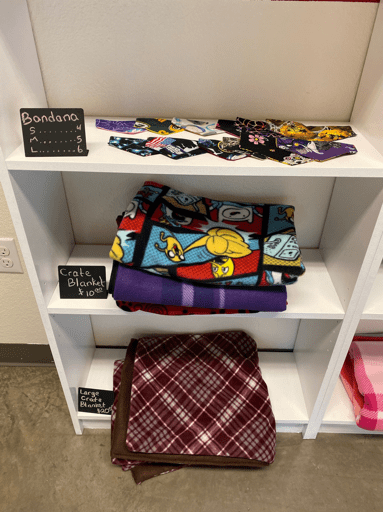
They have expanded to offering bandanas, bow ties, chew toys and more which are all handmade by her and her mother, she said.

While the treats started out as a passion project, “I am incredibly excited about being able to bring a unique product to the market which is also good for pets,” she said.

Lori Garcia standing in front of her store located at 1751 Bellamah Avenue Northwest, Suite 2111
Crate blankets designed and created by Lori and Toni Garcia
Bow ties created and designed by the Garcias
An example of one of many different types of treats Pawsitively Appetizing offers.

Rust Fund

By E.C. McRoy, Staff Reporter

The Rust Opportunity Assistance Fund is an emergency scholarship designed to help students with unexpected financial situations that could prevent the student from continuing their education or cause them to drop out of school, according to Clint Wells, executive director of the CNM Foundation.

The Rust Fund can be used to replace stolen equipment that was bought for classes, but can be used for other things as well.

“This stuff is still hard for me to see. A student became homeless after her house was flooded with sewage and needed help with her first month’s rent,” he said.

The expense is then unexpected and without them, students no longer have the ability to complete assignments.

The Rust Fund can’t help every student, says Wells, but it is the Foundation’s goal to ensure that finances aren’t what stops a student from reaching their educational goals.

A student or faculty member may receive the fund once per twelve month period, according to Luis Villa, scholarship technician at Financial Aid and Scholarship Services.

Students are required to submit an application along with a personal statement, supporting documents of the financial emergency, two letters of recommendation and information for the payee, he said.

Villa said that the funds are disbursed to the vendor or provider, not paid directly to the student.

The fund cannot be used to pay for tuition, insurance or car payments, or cell phone or cable bills, he said.

Wells said the Rust Fund doesn’t usually provide scholarships over $1,000 and the event triggering the fund must be an unforeseen financial burden.

The foundation has always tried to provide funds for students in need, but didn’t have specific funds designated for financial emergencies, he said.

“We have a lot of students that have had medical situations that put them in the place of thinking, ‘well, do I take on more hours at work and drop out of school or do I stay in school, can I stay in school with this debt?’” said Executive Director Wells.

The Rust Fund is one of the larger scholarships available in terms of the amount of money awarded every year and the number of students that can be assisted, he said

Over $1 million in funds have been allocated to nearly 3,000 students since the fund has was originally established by Donna and Jack Rust in 2003.

“It’s not a hard sell to think about one incident could clip you, could take you out of school is something all of us would like to prevent,” said Wells.

Students can donate as well via the foundation’s online website under the Rust Fund, he said.

The funds are kept in a savings or investment account, allowing the funds to build and renew until they are disbursed and there is also a cash account that donors add to each year, he said.

In Search of a President

By Chloe Fox

Staff Reporter

Julie Leidig

Julie Leidig is currently the Provost of the Loudoun campus of Northern Virginia Community College. Her previous experience also includes being Vice President of Instruction at Lone Star College and Director of Instructional Programs, Community College Division at the Texas Higher Education Coordinating Board. Leidig has 4 degrees, including a Ph.D. in Educational Administration from The University of Texas at Austin.

Q: One of the things that CNM is doing now is developing a Spanish language humanities program, which is different from other programs in that the goal is for students to get a degree in their native language. If you were president here, would you support more initiatives to look at the possibilities of programs like the Spanish language program, which are there to serve the population where that language is always going to be their strongest language?

A: I think it’s our job to serve the community where the community needs to be served. If it serves students, if there’s a niche for them, if there’s employment for them in the Spanish language and they need skills in Spanish, I think we’d eventually like to encourage them to become bilingual and learn English, but I assume the college did research on this and there’s a need. I don’t see myself coming in and reversing that. When I was in Texas there were state laws against programs like that, but I am glad you have the ability.

Q: The South Valley campus is one of our smaller campuses in our system, and the campus has struggled with enrollment and having a campus identity to serve the community in a thoughtful way. If you were selected to be president, what might you do to help address the concerns of this community, and this campus?

A: I have a real heart for small campuses. I currently have a small campus attached to my campus, and I also had one at Lone Star College. I’ve grappled with those kinds of issues before. A couple of strategies that I’ve tried that have worked are taking a program that everyone wants and putting it specifically at one location so everyone has to go there. It might not be the best approach for this campus specifically, but it is one way to boost enrollment at a certain campus. The idea here would be to look at the population that lives around this area and ask what the best programs are to serve that population, and the draw to the campus. Having toured this campus today, I think it could probably use some renovation. I think you’ve already got some great programs here. I’d want several strong programs that would be a draw, to build on, especially for the population that either lives or works close by. You have to be realistic about what will draw people to a particular location. You aren’t really obvious just driving by, it would be easy to drive by and not even notice that you’re here, so that may be a factor as well.

Q: Recently, Governor Lujan Grisham announced her plans for free college. What are your thoughts about that proposal?

A: I think free college could be a great thing, depending on how it’s done. I think free college is most important for those who could not afford to go otherwise. I’m one of those people who think that free college isn’t the best thing for people who could afford tuition. Your tuition at CNM is very low, so making college free for people who could easily afford your tuition means you’re using state resources for that rather than other important things. I would like to see college be affordable for everybody that needs to go. If it’s going to be free then I want it to be done well and I want to see the college be well supported. My biggest concern about free college is does the college continue to get the support it needs to be an excellent college that can deliver everything with quality? I want to see anything that will encourage people to take advantage of education.

Q: You have experience in Texas and Virginia, what attracts you to New Mexico and CNM to look at for being president?

A: Well, I’m going to start with what attracts me to CNM. I’m really looking for a place where I can make a difference, and CNM has done some amazing things. You have a great balance between technical programs that have excellent equipment and great partnerships, and also with the general education and transfer programs. I love that you’re in a wonderful, vibrant community, which is a creative place and a beautiful place as well, which doesn’t hurt either. To me, the thing that really attracts me to CNM is that you have your values statement. I love the way this college talks about itself. Since I’ve been here, people have told me that they love the values and they apply the values, they weren’t just written down and forgotten. I would like to work with a group of people that has those values.

Q: The DC metro area that you come from has a much different socioeconomic climate than Albuquerque. What are your plans for increasing the amount of job placement for our students once they graduate, and what are your plans for any partnerships with any local businesses in order to increase that number?

A: I think you’ve got a lot of good partnerships going on already, so there’s a lot to build on there. A lot of it is working with the chambers of commerce and all the local business groups and finding out where the employer needs are, and then showing how the employer needs connect with CNM’s programs. At my campus, we are perched on the edge of some of the millions of square feet of data centers. We started a program to train people who are the operations techs, or the critical infrastructure people for the data centers. Everyone is dying to get the graduates of this program, because the people they have been employing are mainly veterans that worked on nuclear submarines, as they’re the ones with the closest experience. You want to find employers that are hungry, and say hey, we have this program we’re going to give you. The ideal thing would be to find employers who will guarantee that they’re going to hire if students graduate in good standing from your program. The other thing is if you have limited resources and you’re trying to decide where to put them, I would put my resources where it’s benefitting students the most.

Q: What is your experience with non-credit instruction, workforce development, and workforce training and revenue generation?

A: I have had, at both Lone Star and NOVA, workforce development under me. When I had it under me, I started quite a few programs in that area. At Lone Star, we started a personal trainer program, front as well as back office for medical offices, and we did an innovative thing where we did a dual credit program for welding on the CE side. People would graduate from High School and get certified in welding, but not with credit, with an industry certification. At NOVA, I started with workforce development under me and we run a lot of cyber security programming, and we’re doing apprenticeships. Right now, because our workforce development is focusing heavily on IT, they could be focusing on other potential programs but they don’t want to spend the time. I’m very supportive of workforce development and work with them a lot.

Q: What’s your leadership style, and what do you value in a team to support you?

A: I’ve worked very hard to build my team at the campus, and it’s taken some years. I’m very proud of the team that I have. I really like to have a positive group culture. I like for people to feel comfortable coming to talk to me.

Q: CNM’s values are caring, courageous, connected, exceptional, ethical, and innovative. What’s your favorite?

A: I think caring undergirds all of them because if you care, then that springs into all of the rest of the values. If you care then you become connected, and if you care enough to be ethical, innovative and courageous, I think courage comes from caring also. So, I would say caring is the one that underlies all of them.

Q: Would you support the transition to student owned computers/iPads/phone technology?

A: Is that being proposed? What about the students who can’t afford that? I’ve heard that proposal before, the reason we never did it was because we were always concerned that not all students can afford that. I might support it if there’s a way of financing it for the students who simply can’t afford that. And then the question is how do we make it equable? Because if you’re buying something simple for students when there are other students who can afford something really…I don’t know. I would have to see details on that one. I’d want to know why you’d want to do it.

Q: Across CNM’s campuses, our enrollment is about twice that of your current campus. What do you see as your biggest challenge in adapting to the large number of students that we have across the city?

A: I think the biggest adaptation is that it’s so spread out. I would not be able to be as directly engaged with the day-to-day with everyone. I would really have to look for ways to keep connected with students, and I would have to work at scheduling things at the different campuses. Every job I’ve had has been a big change from the jobs I’ve had before, so I’m not concerned with my ability to adapt. But, I recognize that it would not be the same.

Q: Many of our CNM students are single parents. How would you develop strategies around this group to address barriers to college completion?

A: I think the biggest one is childcare, and I think I would probably not be an advocate of CNM providing childcare on its own because I know colleges that have done that. Colleges that have done that on their own, through their own childcare programs, had to back out of it. Once you back out of it, it becomes very contentious. But, I’ve seen our own college at Lone Star and I’ve seen other colleges effectively partner with local childcare in order to provide childcare in some way. I’ve desperately wanted to do this where I am right now but I haven’t been able to make it happen. The ability to either provide vouchers for local childcare or on-site childcare would be the biggest step you could take toward helping single parents achieve their education. I would really try and find a partnership that could provide some kind of childcare while a student is in class.

Q: What role do you believe CNM plays when it comes to economic development?

A: A huge role. You have a higher unemployment rate here than in some parts of the country, so who else is going to step up and help unemployed and underemployed adults achieve a better life for themselves if you weren’t going to do it? The community college is the entity that always provides hope and new opportunity. Sometimes there’s a post-baccalaureate credential that individuals need that isn’t a masters credential per-se, it’s a higher level of skill. I think the community college can really step in and offer credentialing to professionals who need a new skillset.

Q: We have a collective-bargaining agreement here amongst faculty, do you have any experience with that aspect of supporting faculty?

A: I do not have direct experience with collective bargaining. At Lone Star, the AFT was there. Texas is a right-to-work state so we had the AFT as a voluntary union. I did work with the AFT, our faculty who were members of the AFT, if there were any situations they were involved in in terms of disciplinary action when I was Vice President of Instruction, then I would work with the union representative together and we would partner. So, it would be new to me.

Q: What’s your experience with pathways?

A: In terms of various kinds of pathways, I am a pathway provost as well as campus provost. We have sort of a matrix structure now. In addition to being kind of a campus president, I am the provost for the lab sciences at NOVA, which means I am responsible for the pathway councils. We look at curriculum revisions. We’re also looking at enhancing equipment for all labs across all of the different campuses. The pathway deans and I have been doing tours of the different campuses to see where we have disparities. We put five million dollars last year into enhancing lab equipment for lab sciences across the college. We have negotiated with our closest partner, George Mason University, called NOVA-Mason advanced, so we have a seamless transfer into Mason in a number of pathways. We’re up to almost 85 pathways now, so students at NOVA can opt in to Mason, and once they hit 60 credit hours they roll seamlessly into Mason, become a Mason student, so it’s almost like a co-enrollment plan. We’ve been working on those for the past 3 years. Before I was with the sciences, I worked on the initial IT and Computer Science pathways also. Before we had those pathways, we also worked with four other of our transfer partners in Virginia on what we call Guaranteed Transfer Partnerships. We have guaranteed admissions agreements. Students who finish an associate’s degree at our college with a certain GPA, and meet certain requirements, they have guaranteed admission to any university. Guaranteed transfer partnerships are better because they take the courses, and every single course transfers and applies to their degree. So we now have those agreements with four other universities along with George Mason. Another type of pathway partnership that we’ve had for a long time that we’re now revising is called Pathway to the Baccalaureate. This is with George Mason specifically, but this goes into the high schools. It starts in the last year of high school, and in our county, we’ve had this, until recently we had it with every single high school because that’s how our country wanted to do it. You have a counselor who is embedded in the high school, and this is focused on first-generation, low income, minority, or otherwise at-risk students who are recruited into the program in their senior year of high school. They receive extra counseling and extra supports, and testing assessment while they’re in their senior year at high school. Then they get a lot of extra supports and mandatory advising during the years they’re at NOVA, and then they automatically would roll into George Mason if they wanted to.

In Search of a President

By Chloe Fox

Staff Reporter

Samantha Sengel

            Samantha Sengel has over 18 years of experience at CNM, serving in various roles, most recently as Vice President of Advancement and Enrollment Strategy. In addition to a bachelor’s degree she has a business administration from UNM and an MBA from the University of Phoenix, Sengel is currently pursuing her Doctorate of Education from UNM. She has volunteered as a board member for several local organizations, including serving as a member of UNM’s Industry and Innovation Board.

Q: Higher education faces a great deal of challenges and opportunities here in New Mexico and across the country. As you think about CNM’s future specifically, how would you describe its most significant challenges as well as its greatest opportunities?

A: CNM is an incredible institution. I wouldn’t have been at this college for 18 years if I didn’t believe in the mission and the power of education. The challenges that we face in higher education are not unique to New Mexico or CNM. The world is changing at a faster pace than before. We have an incredible opportunity to design our futures and design our responsiveness, and we have what it takes to build that future. When I think about how we tackle the great challenges of higher education, I don’t believe that it’s insurmountable because I believe in the people that are here in this college. Our faculty is one of the most incredible assets in this community. What we have to do as an institution is invest in these people. If you talk with folks about how I lead, it’s side-by-side with incredible talent, and giving them the resources to move forward with that talent. Recently, we’ve had some incredible conversations about the future of the workforce at Sandia Labs. It’s a challenging conversation to sit with folks from an industry and have them describe a new world, what they need to have, how those skills are different and how they need something different from CNM to support them in their own growth, for this community and for our economic development. But the magic that happens when you bring faculty and administration to that table is they hear these conversations and participate, bringing their expertise to the conversation. This, to me, is exactly why CNM will be a critical part of the future of New Mexico’s economic prosperity. The biggest challenge I see as an institution is how do we keep up, and how do we do it in the CNM way? How do we ensure that we stay true to our values, and stay true to our mission? We have to be thinking in a way that gives us the opportunity to use our assets to diversify funding streams, and diversify our reach into the community. So as we access our people, our processes, and the places we have, we have to look at it from the perspective that CNM is the most incredible, impactful and important higher education institution in the state. We have to be agile. We’ve talked about change at this institution being a constant and change will continue. We will be moving forward and changing, but we also can be consistent about who we are while we make those changes, and that to me will be our greatest opportunity moving forward. We have the opportunity to embrace change with the consistency of the incredible people, processes and places we have right here at CNM.

What is the most important sustainability problem for a college, and what would you do as president to help us achieve that goal?

In 2008, our prior executive director of facilities and I lead the charge of the president’s climate neutrality commitment. We put our heads together and asked ourselves how do we make change, so that the institution is leading in this community around sustainable practices and shifting the opportunities. The number one goal I have is that students leave CNM with an understanding of how to live within our world with sustainable practices everyday of their lives. They have to understand what their individual impact is, and what they can do to change the world as well. Going down the road, we need to move forward in our practices by taking on the additional expense of implementing these practices.

As a president, what could you do along with UNM? I know you’re big on economic initiatives, innovation and entrepreneurial activities but in reality nothing will ever change in New Mexico unless we really bring economic development. How do you see UNM working with you as a future president?

The core of what difference we can have in New Mexico, what does the future depend on? Our future depends on our ability to be agile and effective moving forward, and partnering together so we can go further and make a bigger difference. I serve on UNM’s innovation and industry partnership board to support the greater thinking around how do we move forward together. We need to be systematic and purposeful in how we think about aligning our curriculum between our institutions to industry opportunities and growth in our communities. What are we doing at CNM to insure an open door to UNM? What is UNM doing to insure the door isn’t locked when they get there? What is it that we can do to ensure the learning outcomes lead to employment along the way? We have a responsibility of ensuring that students will be able to provide for their families here in New Mexico. I am going to be a double graduate of UNM. To me, it’s not about us versus them; we are what will take New Mexico forward together. Higher education, and education at its core will be exactly what moves this state forward. I believe in all of our higher education systems, and I believe that if you come from APS or Rio Rancho public schools you can be an exceptional college student. As long as we’re supporting individuals when they get here, and supporting them in their learning, we can provide the workforce that’s required together. So I would hold UNM accountable, I would sit next to them as someone who believes in their initiatives and say let’s do it together.

Currently, part time faculty makes up 70% or so of faculty at CNM. We do exactly the same job as full time faculty, but current administration attitudes and policy are that part time faculty shall have very limited class loads, have no pathway forward to full time employment, and part time faculty are leaving this institution for other states because they can’t make a living here, and they’re told that that’s just the cost of doing business. How would your administration’s relationship with part time faculty differ?

I don’t believe part time employees should be used as full time employees, because that’s mistreatment. It is not appropriate for a part-time employee to be expected to come through as a full time employee. Full time employees receive additional benefits and opportunities as a result of that status, thus we expect more of those positions. Should part time employees have the opportunity to move into full time positions if they so please? Absolutely. And what are we doing to support part time employees in developing either the skills if that’s the issue, the exposure to the opportunities if that’s the issue, the opportunity to be at the table for discussions about making informed processes and empower them to be part of that? Absolutely. All of those things have to happen, and we can create structures to do that. I spoke earlier about people, process and place. People come first. Are we thinking about the people, are we investing in the people, are the right people at the table, are we ensuring that the diversity of voice and thought are at the table? Is our process appropriate? Are we thinking about the ways in which the process might be inhibiting our ability to do something? Are we not building out enough opportunity for part time faculty to engage in other meaningful work in college so that they do get the exposure to the other items that we believe a full time faculty is covering? And then, are we creating an opportunity for our systems and our technology to support that? Does everyone have to be in every meeting face-to-face? But if they don’t, and we say we’re going to create opportunities for people to have remote access to meetings, are we ensuring that that’s incredible access so that they can truly participate in the conversation and their voice can be heard? All of that has to happen as a systematic approach to improving those opportunities for part time faculty and ensuring that we’re moving folks forward. Now I’m never going to back away from my belief that part time faculty play an incredibly important role for us here at this institution. In order to support the amount of students we have it’s important to have the flexibility that part time faculty provide.

How have you prepared yourself to be president?

When I first started at CNM, I had no ideas about the possibilities of this institution. Creating programs like the STEMulus center downtown and the Deep Dive coding program, all of those efforts for me have been about understanding the possibilities at CNM. Most of what I’ve done is figure out how to connect with the people of CNM. I’ve also spent a ton of time raising dollars at CNM. When you think about raising money for an institution like CNM that has such a diverse mission and so many different areas of opportunity, you have to be able to dive in deep on hard and complicated issues. You have to be able to do a self-assessment that says you’re really lacking in this area. I’ve also participated on behalf of all of you many times in the community discussions. One of the most important things I’ve had to do is learn how to interpret from the outside what they’re looking for and what it means for us as a college.

The governor has proposed the free tuition program-what opportunities are there for CNM, and are there also challenges for CNM?

This is very exciting for New Mexico.           Our governor stepped out and made the statement that investing in higher education is the number one priority. We don’t yet know all of the mechanics of the proposal, but the most important thing about it is that the governor is saying investing in higher education is the number one priority. Free tuition, as we all know, does not eliminate all of the financial barriers an individual has when accessing and education. The CNM Foundation will still have to raise funds to support students for book scholarships, for the other life expenses that get in the way. That will be core to our mission at CNM. The most important thing is that we have to be at the table. CNM has got to be part of working on this proposal moving forward. We have to be a part of the analysis, whether that be supporting them through focuses of institutional research, budgeting and planning so they can be part of supporting the analysis and what it looks like, or sitting at the table to support writing the legislation and moving that forward in a way that can support more individuals and access higher education. I’m excited about the commitment that’s been stated, and I think it all comes down to how quickly we roll up our sleeves, sit at the table, and do the hard work.

What is your vision for CNM?

My vision for CNM is that we will be this community’s economic driver, and at the core of this economic opportunity in New Mexico. I believe we’re already there, and we have to keep our momentum in this work. It isn’t done by creating big, corporate-type feel efforts, it’s about being true to our values, true to our vision, and true to the vision we hold so dearly. I believe we can keep that momentum and move forward faster. I believe this engine has the fuel, let’s just put our foot on the gas.

In Search of a President

G. H. Javaheripour

President of Yuba College

Marysville, California

By Bro. Eden Douglas

For almost four decades, G.H. Javaheripour, Ed.D. has dedicated his life to service in public higher education, spanning the academic, student services and administrative services arenas. Dr. Javaheripour began his higher education career at the University of New Mexico in 1978, and his community college career at UNM-Gallup Community College in 2001 when he was named Director of Business Operations. Since then, Dr. Javaheripour has served in executive leadership roles at Santa Fe Community College, Chabot College and Victor Valley College. In 2015, Dr. Javaheripour was appointed President of Yuba College in Marysville, California, a community college providing education and training to students in three counties. In his prior roles, Dr. Javaheripour was instrumental in developing an extended education network across the United States to deliver courses and programs in thirteen states and territories, from Puerto Rico to Arizona. He also developed networks to deliver Bachelor and Masters’ degree programs and K-12 and advanced placement classes to rural communities in New Mexico.

Dr. Javaheripour has held residence in Albuquerque since 1975. He is married to Patsy Maestas-Javaheripour, who taught in both Albuquerque and Bernalillo Public Schools. His daughters, and their families, also reside in Albuquerque.

Higher Education faces a great deal challenges and opportunities, here in New Mexico, and across the country. As you think about CNM’s future specifically, how would you describe its most significant challenges as well as its greatest opportunities?

This is sort of a homecoming for me. I’ve been in New Mexico since 1975. We lived in the North Valley where I still maintain a residence where my wife, my daughters and grandchildren still live and although I work in California, I commute back and forth. As for the challenges of higher education, it all goes back to budgets, enrolment and funding, because without those, nothing else happens. Our enrolment goes contrary to the economic conditions of the country; when the economy takes a downturn, community colleges enrolment increases. In order to have a steady ride of income and revenue, we’ve got to be able to think about how to predict our enrolment as much as five to ten years out. We can do this by looking at the data concerning birth rates and within a small percentage of error, we can identify how many students will be graduating from public school in a given year and what is our share of that student population. We have to proactively consider how we can pipeline those students into our community college enrolment.

It happens that in California, Guided Pathways tracks student’s aptitudes and colleges that are part of this program, have access to this data that allows us to identify, early on, potential students and their unique needs. With CNM’s participation in this program, we can work with counsellors and teachers and assist in helping students not to meander, and focus on the subjects that will make their college experience, more beneficial, identifying CNM as the most likely progression to achieve their goals, because of this early interest in their education. This is obviously a long term goal. In fact, it’s taken as much as 18months for the faculty to come aboard, to implement this program at my present college (Yuba), so I know this has to work from inside, out, and it begins with the faculty of the community college. In the short run, we have to think about what we can do about enrolment, now. It begins with supporting the students that are interested and helping them create a path to the goals they desire, with guided faculty support, especially in doing the online studies. We need to have a system in place that spoon feeds the new students ‘till there’s an obvious rhythm in place, especially when they go home to do their assignments. Tutoring is crucial, we need a system in place that ‘taps’ these students on the shoulder when we see them failing to turn in homework on time or those with extended absences. Sending an email or text to check in, works wonders. So, what’s in front of us? It’s planning, in order to be relevant, but to implement those plans, we have to have resources which means enrolment and we have to think about all of this in short and long term perspectives. Saving up in the years when enrolment is down, as predicted by that data on birth rates, to be sustainable in the years when enrolment is up.

What are you going to do make our Applied Technologies, better?

In community colleges, there are three pillars: one is basic and remedial education, the other is transfer programs to degreed universities and the third one is applied tech. For those members of our communities that need a trade and wish to become producers, and earn income within 18months, applied technologies is crucial. It is also the most direct service to our local communities as the education reflect the jobs most needed in the community. In order to support this, we have to have the latest equipment, because their potential employers will. I am formally committed to seeing those students trained for excellence once they graduate. Because those graduates will eventually have their own companies and will be invested in hiring students from the school that produced them.

What are your ideas and philosophies on how technology can affect enrolment and the student experience?

Our students live with their phones. They die without that access to social media. I feel if they lose their phones, half of their life disappears. Our enrolment services, rightly so, are supported by this technology. Students register, purchase books, interact with one another and do homework, with technology. It is not an option for us, it’s a must. We need to support our faculty to structurally integrate their courses with more technology, especially, as we launch the comprehensive Attend Anywhere methodology that will increase the amount of technology and support needed to be successful. The drawback is that when we teach face to face, you can scan a classroom and see who is understanding your assignments and who isn’t connecting, but in digital modality, this isn’t possible. So there’s a level of support needed to understand the psychological and relational aspects of this teaching tool. But when I also think of technology, I’m not just thinking digitally. There’s technology interwoven in the applied technologies, as well. Most of the equipment, now, has some technological aspect to it. So we need a budget, a master technology plan, that reflects out true needs, presently and going forward.

With Adjunct Faculty at CNM representing nearly 70% of total faculty, what is your relationship to this group at your present college? What do you see as the role of adjunct faculty and what is your direction or vision for them in your administration?

Well I was an adjunct faculty, so I understand that in most colleges, this group is a mainstay and most integral. As a rule, because of the work schedule, you’re not represented in the governing board of faculty. Presently, I have a program that allows adjunct faculty to paid an hourly rate to attend those meetings and I’ve instituted a program that recognizes outstanding members of this group in a year end ceremony. The reason the number is imbalanced is economic because of all the built in incentives that are part of the faculty packages, so there has to be a reliance on adjunct faculty. I’m not sure I’ve answered your question, unfortunately, it is what is it, but I am sympathetic that there is something more we need to do about it.