Cameroonian student Pul Gual said he perfectly understood the decision made by the school to suspend all in-person classes.
Switching to an online only format for the rest of the semester makes sense, he said
“I think it is the right decision to help slow down the spread of the virus,” said Gual.
Environmental planning and design student Sonia Cabrera agreed with the decision to convert all classes to an online only format.
“At first I thought it was pre-mature and reactionary, but with how quickly the virus spreads, I think they made the right choice,” said Cabrera.
Alexis Botello full-time radiologic technology major said the most difficult thing about working from home is “Just all the distractions mostly. I feel like it’s harder to stay focused and get everything done if you’re not in the right environment.”
“I have to be more responsible and dedicate more time from my home life that I’m not used to doing,” she said.
Having to be more responsible and trying to dedicate more time while at home is something that takes some getting used to, she said.
Other students described difficulties in the transition to online classes, like Gisselle Rascon, who said “It makes it more difficult for me to keep up. So many things are being switched up and it’s difficult to know what’s going on in each class.”
Ysabel Solis, a part-time cosmetology student said it can feel like work isn’t getting done because it’s easier to ignore stuff online and it could result in more students failing.
Cortez Martinez, a full-time liberal arts major said, all of his teachers have reached out and been extremely helpful in this process of switching the format to online.
Cortez also said that the transition has been made easier by Blackboard, saying it is “definitely a big help for the time being.”
Additional up to date information regarding COVID-19 and CNM can be found at www.cnm.edu/covid-19.
Story & Photo illustrations by Staff Reporter Olawale Oluwakoya
The global education at CNM is an organization that envisions and projects the best possible experience for foreign student during their time in America, said Joe Leetsma the Global Education Program Coordinator.
With a team consisting of specialized designated school officials including Director Ari Rosner-Salazar, International Student Officer Diana Matier and Leetsma, their goal is to bring diversity and internalization to the CNM campus, he said.
Mechanical engineering student Ahmed Saoudi, praised the organization, claiming international students at CNM are treated to weekly outings that familiarize them with the city of Albuquerque.
Global education is an important organization at CNM that prides itself on aiding international students to succeed in the US, while also providing the opportunity for Americans to study abroad, said Rosner-Salazar
“When the organization started there was an assumption that there would be a lot of students, the initial goal set in 2015 for our organization was a total of 130 international students and right now we have 32 students,” he said.
CNM global education had never faced any major problems dealing with the federal government, however, around 10 to 30 percent of prospective students have their visa denied “every school has that issue”, the global ed. also faces stiff competition from other countries like Canada that provide a path to citizenship, he said.
Diana Matier claimed global ed uses allocated funds on recruitment trips to several countries every year, to educate other countries on the how a community college works.
“We want to help students interact with others, learn about different cultures and feel at home here in the beautiful city of Albuquerque,” she said.
Since the organization started in 2015, it has enrolled fifty-nine students from twenty-nine different countries from all over the world the group works with government sponsored Travel U.S.A, but Matier emphasized that it is “not a direct partnership”.
“I love my role in this organization, I oversee the intensive English language planning events and general finances of the organization, I rely on students’ feedback and places that are exclusive only to Albuquerque when planning events for the international students,” said Joe Leetsma.
Ryan Agosto-Hayes from CNM’s Financial Aid Office has confirmed that CNM is open, and that student employees should report to work normally, unless they are notified differently by their department.
Financial Aid Tech Joseph E Ryan, added that “CNM understands that some student employees might not be able to work due to the impact of COVID-19 on their lives.”
He asked that students be assured, that if they are unable to come to work, due to COVID-19 related life disruptions, such as lack of childcare, etc., they can still be paid for their regularly scheduled hours.
According to Ryan, “This will be in effect while CNM is in its modified mode of college operations (Monday, March 16, through Sunday, April 5).”
If a department chooses to send student employees home, and CNM is not closed, they will not be paid for missed hours.
If CNM is closed, students may claim hours on their time sheet that matches their normal schedule, up to 20 hours per week, for the duration of the closure.
Hiring will be frozen in the event of a closure.
If new student employees have a start date before the closure, they may claim hours as well.
If a new hire is still pending, he/she will be frozen until the campus returns from the closure.
UPDATE: As of Monday March 16th campuses are not fully closed but face to face classes have been suspended until further notice. Classes will be conducted in an online format by faculty to ensure spring semester continues.
This evening, March 13th, the CNM management team has informed students, faculty, and staff that CNM campuses will be closed for the next three weeks with a planned reopening on Monday, April 6th in response to the COVID-19 outbreak.
Students, faculty, and staff are all encouraged to cancel any meetings in person that are not critical and can otherwise be conducted virtually.
The closing of CNM’s campuses does not mean that students will not graduate nor does it mean that students will no longer have classes, however, students should expect a modified format to those classes.
For those classes which are on-campus, many will adopt an alternative remote learning format on a class by class basis.
Students will be contacted by their instructors the week of March 16th on how they will be proceeding; students should check their CNM emails regularly for updates.
Classes which already utilize online learning will proceed as normal unless otherwise indicated by CNM officials or professors.
Despite being closed, certain aspects of CNM shall remain open, but they will be keeping a suitable distance of six feet from others and taking extra preventative precautions to ensure the virus does not spread.
It is CNM’s goal to continue providing instruction and help to complete the Spring Term as planned despite the school closure.
This includes not only providing online instruction where available and resources despite the closure, but also in ensuring that employees and student employees will continue to be paid during the three-week closure of CNM.
CNM plans on a deep cleaning of all CNM locations in an effort to deal with the coronavirus.
Any individual who has symptoms of the coronavirus should call the New Mexico Department of Health Coronavirus Hotline at 855-600-3453.
The goal of CNM’s efforts is to reduce the spread of the coronavirus and to keep students and staff safe.
The CNM management team will continue to keep students and faculty informed as COVID-19 develops and will keep working as quickly as possible to address concerns surrounding the virus and its impact on CNM.
COVID-19 commonly known as the coronavirus has arrived in New Mexico, but Mayor Tim Keller said that the city is ready and has been preparing for the arrival of the virus for several weeks.
Mayor Keller said that it is the city’s responsibility “to answer this call to action by continuing our operations that the public relies on every day.”
Keller said that those City facilities that are frequented by the public are scheduled for regular and additional cleanings.
Currently, public services and offices are running normally; the City will update the public with developments moving forward, said Keller.
Albuquerque will be following the same guidelines as the NCAA in regards to athletic events and public events will be reviewed to determine if postponement or cancellation will be necessary, according to Keller.
The City has activated the City Emergency Operations Center and Joint Information Center as a means of handling the response to the virus, said Keller.
Public safety is a priority for the City, said Keller, and public safety services and first responders are prepared to take care of the local response.
“[Albuquerque is] participating in national networks of emergency medical providers … to share information, expertise, and knowledge,” said Keller.
Keller said that the City is banning out of state travel for employees when it is unnecessary and those who are able are encouraged to telecommute.
COVID-19 is spread person-to-person via coughs or sneezes and has similar outward symptoms to the flu including fever, coughing, and respiratory problems, said Keller.
“It is critical that anyone experiencing symptoms [of COVID-19] not go straight to doctors or hospitals,” said Keller as this could compromise medical resources.
Keller also stated that 911 continues to be an emergency number and those with non-emergencies who are experiencing symptoms should call the New Mexico Department of Health at 855-600-3453.
The public is encouraged to stay home if sick, avoid large events, and for individuals to their hands, said Keller, but is important to be reasonable.
Hoarding supplies such as soap, food, and other basic goods is “inappropriate and detrimental” to handling the crisis, said Keller.
“Stigma and xenophobia will drive suspected cases underground and aid the further spread of the virus,” said Keller. “Coronavirus does not discriminate based on race, ethnicity, or any other demographic factors, and neither should we.”
Keller said that we should “show compassion and support” instead of discrimination.
A survey of several CNM students suggest that the community supports the idea of a woman becoming president, though whether or not an election will put a woman in office is uncertain.
CNM freshman student Kyra Martinez said, “a lot of women can lead a country.”
Kyra Martinez CNM Freshmen
Martinez said that it takes a specific type of person to run a country, a person like Bernie Sanders as opposed to Hillary Clinton who took the popular vote last election.
Martinez said that a woman’s ability to run a country comes from her ability to “stop thinking about a business and start thinking about the welfare of its people” stating that if she doesn’t “you can’t run jackshit.”
A president shouldn’t think it’s all about money, according to Martinez, and that a woman cannot expect to win if she addresses the presidency like a business.
Martinez said on Clinton, “Yes, a woman can run a country, but not when you’re a social justice person who doesn’t have the right idea on how to run a country.”
Women may be more inclined to run for Congress, rather than the presidency, which may impact why a woman is not president, says Martinez, citing Alexandria Ocasio-Cortez.
“So yeah I think a woman can run a country but you gotta make sure she’s not a socialist idiot,” said Martinez.
Work-study student Gabriel Providenti said that people can support a socialism that would improve lives and that the US should consider taking cues from other countries that have women running them.
Providenti said that our country “is kind of stuck in the old ways of thinking. We have too many old white men running it.”
Evelyn Nevarez Munoz, a secondary education major, said that that there is a “slight chance” that a woman could win the presidency, however, there is a prevailing idea that men are stronger leaders than women.
Gabriel Providenti, CNM Work-study student
“But I think we’re growing as a society, definitely,” she added, saying that it depends on hard work and determination to represent the country that is the real deciding factor.
When asked if Munoz would vote for a woman even if she thought a woman could not win, she said, “Yes, I would. Definitely. Yeah, there’s no difference between what a man and a woman can do. Their goals and ideas are what matter for the country at the end of the day.”
Although Munoz said that it seemed that women would be more supportive of a woman president, she admitted, “everyone has different thoughts regardless of what gender they are.”
Discrimination is a likely culprit of a woman staying out of office and men may not be as aware of that discrimination as women, said Munoz.
Munoz went on to say that men are less likely to understand discrimination against women or minimalize it because “they don’t experience it. They’re very ignorant towards it.”
Integrated studies major Pablo said that people should be open to new ideas, not just falling into the familiar, old ways.
Duenas said that generational differences could impact an election, because of differing beliefs, including gender stereotypes.
“I feel like now is a good time [for women to strive for powerful positions] … generations have changed,” said Duenas.
Duenas said that his long-time girlfriend is involved in women’s rights activism and that has encouraged him to “strongly believe that any woman if they put their mind to it can do anything a man can.”
Duenas continued by saying that a woman could win if everyone were to vote.
“There’s a lot more of women politicians, I feel like gender shouldn’t be holding someone back from what they want to pursue,” said Duenas.
President Tracy Hartzler, president of CNM since January 1st, 2020, said that she has always been surrounded by women leaders and it is the public conversation that makes a difference to determine whether a woman can win the presidency.
Hartzler said she went to a women’s college and was surrounded by strong females who have shown that they not only can be leaders but do well in those positions.
“Can women be president [of the USA]? Of course,” said Hartzler.
Hartzler said that while women have always sought power and people take for granted that a woman can run for president now as well.
Having a woman on the presidential ticket as a presidential candidate or a VP once was a novelty; “I don’t think it’s a novelty now,” said Hartzler.
Personal experience has shown that women are able to find compromises and to negotiate, according to Hartzler.
While historically women may have been limited to career paths in education or caregiving, those options have changed, and Hartzler said that women have always led even if that hasn’t been in political offices.
Hartzler said that things are often portrayed as black and white, but that isn’t a fair representation and this doesn’t encourage a thoughtful response or conversation.
“I think what is challenging is the public discourse doesn’t favor compromise,” said Hartzler. “I just think the discourse now is hard. It’s hard to be thoughtful.”
In the last U.S. Election, Hillary Clinton won the popular vote and Hartzler said that the popular vote is important because of how it changes the conversation.
The conversation is important according to Hartzler, because it’s difficult to govern without taking into account what the people want.
The goal is bringing people together and women do so in a different way to find solutions.
“You want people to shape the conversation and I think what we miss … is that public service is a tremendous honor and it’s a tremendous responsibility to serve your fellow residents,” said Hartzler.
Hartzler said that those students interested in making a difference should participate in government at all levels, to “go out and run, make a difference. Challenge us.”
According the Hartzler the biggest thing is to engage and participate even if it is only at the most basic level.
At a minimum, those who wish to make a difference should go out and vote, said Hartzler.
Those with more ambition can look at volunteering on a campaign, running for government or student council which affects CNM on a local level, said Hartzler.
“No matter his or her background or political views, you want everyone to participate in the process because dialogue is so important to make a better process for a better solution,” said Hartzler. “And I think that is gender neutral.”
Hartzler said governing needs to be inclusive and everyone should be encouraged to participate, because we need to work together to accomplish things successfully.
Participation shows how institutions and governments have a role that impacts the community and our involvement in those institutions makes a difference, said Hartzler.
The U.S. is a republic with an electoral college that the public follows which can allow for polarization and attempts to reconcile the representative vote and the popular vote, said Hartzler.
“We all have a responsibility to participate,” said Hartzler.
Picture below provided by CNM’s Presidential Office.
Tracy Hartzler, President of CNM since January 1st, 2020.
The exterior of Max Salazar hall on December 5th, 2019
According to project manager Peter Siebert, the renovated Max Salazar hall features improvements such as added ‘agility spaces’, which Siebert said are equipped with various features such as adjustable color mood lighting, intended to help carve out spaces for students to be productive and comfortable at the same time.
One of the ‘agility spaces’ mentioned by Siebert to help improve the overall student experience in Max Salazar.
Siebert said that an emphasis on improving the technology in the building was at the forefront of the project. A new wifi network, televisions, LED lighting, and self-filtering windows are a small portion of what has been added to the space.
An example of the new LED lighting systems, showcased in an agility space.
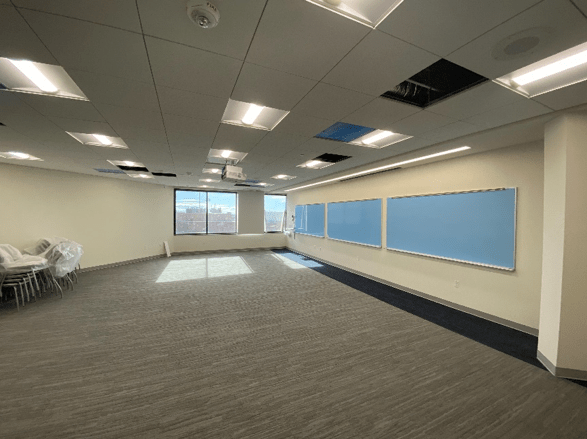
A completed 4th floor classroom.
Siebert said that one of the new technological features is the electrochromic windows, which automatically tint throughout the day and give full control to instructors of the amount of light filtering into their classrooms.
CNM is one of the first schools in New Mexico to utilize this technology in the classroom setting, he said.
An additional view of a completed 4th floor classroom.
In terms of inclusivity, Siebert said they’ve added two new single stall bathrooms to each floor in order to help students and faculty feel more comfortable.
A new classroom, part of the front expansion of Max Salazar. This classroom features the new electrochromic windows.
The administration and faculty spaces on the 5th floor are being completely renovated, Siebert said.
There will be more collaborative spaces for students and faculty alike, and there has been an emphasis on improving natural light in those spaces, he said.
[adrotate banner="2"] AD
A new reception desk will help students and faculty locate whomever they need to get in touch with, said Siebert.
The new reception desk in the administration and faculty offices located on the 5th floorThe new lobby in the administration and faculty offices on the 5th floor.Additional student/faculty meeting spaces on the 5th floor of Max Salazar.The new addition to the front of Max Salazar hall includes all new classrooms, set to open a few months after the rest of the Max Salazar project according to Siebert.
Siebert said the building was built in 1991, which means a gut renovation was required in order to bring in the necessary improvements.
New sustainability efforts have been put in place including exterior telescoping solar arrays which move with the sun, all new LED lighting systems, as well as new meters for all utility usage in order to monitor the building’s consumption and using all LEED certified materials for construction, said Siebert.
For almost four decades, G.H. Javaheripour, Ed.D. has dedicated his life to service in public higher education, spanning the academic, student services and administrative services arenas. Dr. Javaheripour began his higher education career at the University of New Mexico in 1978, and his community college career at UNM-Gallup Community College in 2001 when he was named Director of Business Operations. Since then, Dr. Javaheripour has served in executive leadership roles at Santa Fe Community College, Chabot College and Victor Valley College. In 2015, Dr. Javaheripour was appointed President of Yuba College in Marysville, California, a community college providing education and training to students in three counties. In his prior roles, Dr. Javaheripour was instrumental in developing an extended education network across the United States to deliver courses and programs in thirteen states and territories, from Puerto Rico to Arizona. He also developed networks to deliver Bachelor and Masters’ degree programs and K-12 and advanced placement classes to rural communities in New Mexico.
Dr. Javaheripour has held residence in
Albuquerque since 1975. He is married to Patsy Maestas-Javaheripour, who taught
in both Albuquerque and Bernalillo Public Schools. His daughters, and their
families, also reside in Albuquerque.
This is sort of a homecoming for me.
I’ve been in New Mexico since 1975. We lived in the North Valley where I still
maintain a residence where my wife, my daughters and grandchildren still live and
although I work in California, I commute back and forth. As for the challenges
of higher education, it all goes back to budgets, enrolment and funding,
because without those, nothing else happens. Our enrolment goes contrary to the
economic conditions of the country; when the economy takes a downturn,
community colleges enrolment increases. In order to have a steady ride of
income and revenue, we’ve got to be able to think about how to predict our
enrolment as much as five to ten years out. We can do this by looking at the
data concerning birth rates and within a small percentage of error, we can
identify how many students will be graduating from public school in a given
year and what is our share of that student population. We have to proactively
consider how we can pipeline those students into our community college
enrolment.
It happens that in California, Guided
Pathways tracks student’s aptitudes and colleges that are part of this program,
have access to this data that allows us to identify, early on, potential
students and their unique needs. With CNM’s participation in this program, we
can work with counsellors and teachers and assist in helping students not to
meander, and focus on the subjects that will make their college experience,
more beneficial, identifying CNM as the most likely progression to achieve
their goals, because of this early interest in their education. This is
obviously a long term goal. In fact, it’s taken as much as 18months for the
faculty to come aboard, to implement this program at my present college (Yuba),
so I know this has to work from inside, out, and it begins with the faculty of
the community college. In the short run, we have to think about what we can do
about enrolment, now. It begins with supporting the students that are
interested and helping them create a path to the goals they desire, with guided
faculty support, especially in doing the online studies. We need to have a
system in place that spoon feeds the new students ‘till there’s an obvious
rhythm in place, especially when they go home to do their assignments. Tutoring
is crucial, we need a system in place that ‘taps’ these students on the
shoulder when we see them failing to turn in homework on time or those with
extended absences. Sending an email or text to check in, works wonders. So,
what’s in front of us? It’s planning, in order to be relevant, but to implement
those plans, we have to have resources which means enrolment and we have to
think about all of this in short and long term perspectives. Saving up in the
years when enrolment is down, as predicted by that data on birth rates, to be
sustainable in the years when enrolment is up.
In community colleges, there are three
pillars: one is basic and remedial education, the other is transfer programs to
degreed universities and the third one is applied tech. For those members of
our communities that need a trade and wish to become producers, and earn income
within 18months, applied technologies is crucial. It is also the most direct
service to our local communities as the education reflect the jobs most needed
in the community. In order to support this, we have to have the latest
equipment, because their potential employers will. I am formally committed to
seeing those students trained for excellence once they graduate. Because those
graduates will eventually have their own companies and will be invested in
hiring students from the school that produced them.
Our students live with their phones.
They die without that access to social media. I feel if they lose their phones,
half of their life disappears. Our enrolment services, rightly so, are supported
by this technology. Students register, purchase books, interact with one
another and do homework, with technology. It is not an option for us, it’s a
must. We need to support our faculty to structurally integrate their courses
with more technology, especially, as we launch the comprehensive Attend
Anywhere methodology that will increase the amount of technology and support
needed to be successful. The drawback is that when we teach face to face, you
can scan a classroom and see who is understanding your assignments and who
isn’t connecting, but in digital modality, this isn’t possible. So there’s a
level of support needed to understand the psychological and relational aspects
of this teaching tool. But when I also think of technology, I’m not just thinking
digitally. There’s technology interwoven in the applied technologies, as well.
Most of the equipment, now, has some technological aspect to it. So we need a
budget, a master technology plan, that reflects out true needs, presently and
going forward.
Well I was an adjunct faculty, so I
understand that in most colleges, this group is a mainstay and most integral.
As a rule, because of the work schedule, you’re not represented in the
governing board of faculty. Presently, I have a program that allows adjunct faculty
to paid an hourly rate to attend those meetings and I’ve instituted a program
that recognizes outstanding members of this group in a year end ceremony. The
reason the number is imbalanced is economic because of all the built in
incentives that are part of the faculty packages, so there has to be a reliance
on adjunct faculty. I’m not sure I’ve answered your question, unfortunately, it
is what is it, but I am sympathetic that there is something more we need to do
about it.
Vice
President of Boulder County Campus of Front Range Community College
Longmont,
Colorado
Dr. Elena Sandoval-Lucero is the vice president of the Boulder County Campus of Front Range Community College (FRCC). She serves as CEO of the campus, and represents the campus, and the college throughout Boulder County. Dr. Sandoval-Lucero has 30 years of experience in academic and student affairs settings in higher education. She has led strategic planning efforts and developed enrolment management plans at multiple institutions. Dr. Sandoval-Lucero earned her Bachelors’ degree in psychology from the University of Northern Colorado. She earned Masters’ degrees in Administration, Supervision, and Curriculum Development from University of Colorado Denver, and Psychology from American Public University. She earned her doctorate in Educational Leadership and Innovation from the University of Colorado Denver. She teaches in the higher education program at the University of Denver, and has presented, researched, and written about the field of higher education.
Higher Education faces a great deal
challenges and opportunities, here in New Mexico, and across the country. As
you think about CNM’s future specifically, how would you describe its most
significant challenges as well as its greatest opportunities?
Community colleges in general, don’t do
a good job of telling their stories. In order to remedy this, we have to decide
what our story is, then create an elevator speech (one that can be told in two
to three minutes, in the time it takes in a normal elevator ride); here’s who
we are, what our values are, and why we’re positioned this way in the
community. Next, establish relationships beyond the Community College with the
out-laying community. On the subject of resources, we have to ask a different
question instead of how do we find students, ask how do we get students to come
to us. You have to discover what students you’ve lost and work to bring that
neglected group back into the fold. If they’re your more mature students, heads
of households, we have go to their jobs and see if we can work on solutions
that give employers incentives to allow their workers to return to school.
Because I come from a Financial Aid background, I know that the number one
issue of reenrolment is financial, but if we can relieve some of that burden,
we can improve that application to enrolment process. Another issue to resolve
is to make sure it’s convenient, schedule-wise, for students to follow simple
maps to graduation because of where and how classes are scheduled (reduce
conflicts).
What are you going to do make our
Applied Technologies, better?
All decisions should be about what’s
best for the student. There are areas where the interests of the students
overlap between departments and we need to explore and exploit those
intersections.
What are your ideas and philosophies on
how technology can affect enrolment and the student experience?
In Colorado, our campuses are truly
spread out, nearly 40 minutes apart in some cases, so it was inefficient to try
and drive to those campuses on a regular basis. Instead we put a poly-conference
center on all the campuses, that intra-connected those campuses. The upside was
it allowed the administration to be more present on all of their separate
campuses because of the less travel. Ultimately, we need to make sure our
technology infrastructure stays current and that it’s maintained and make that
a line budget item.
With Adjunct Faculty at CNM representing
nearly 70% of total faculty, what is your relationship to this group at your
present college? What do you see as the role of adjunct faculty and what is
your direction or vision for them in your administration?
I’m a big proponent of professional
development. For the first two years of a new hire, it’s all about them
creating a style that works for them and in the third year, there’s an assessment
that allows them to shore up the areas that are exposed as weaknesses.